Lake Mead falls to its lowest level on record, and receding water exposes human remains at Boulder Beach
The largest reservoir in the United States has fallen below its 2022 record, and the shoreline it is uncovering keeps producing the same kind of discovery.
World Affairs Editor ·
Why it's trending
Lake Mead trended in the UK on 19 August after human remains were recovered from a beach exposed by the falling water line.
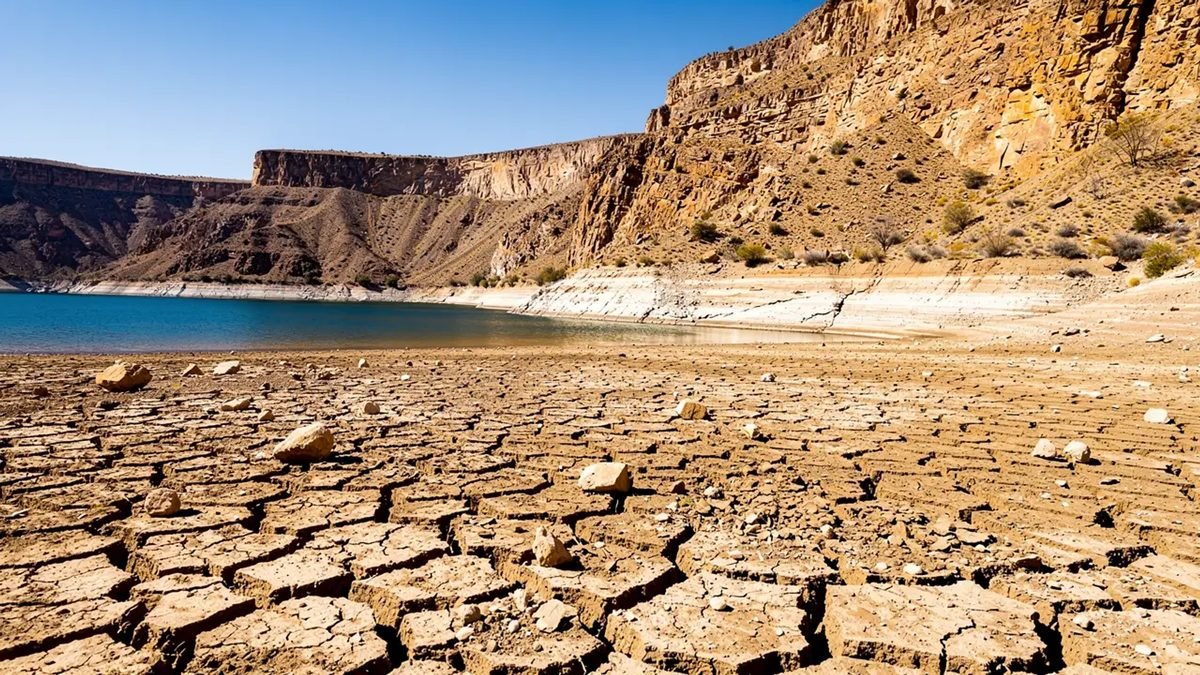
Lake Mead, the largest reservoir in the United States, fell to 1,040.50 feet above sea level on 7 August, dropping below the previous record low of 1,040.58 feet set in July 2022, according to data from the US Bureau of Reclamation.
Nine days later, on Sunday 16 August, visitors to Boulder Beach in the Lake Mead National Recreation Area found human remains in shallow water. The report was filed before 4pm. Las Vegas Metropolitan Police and the Clark County Office of the Coroner responded, and the investigation into the identity of the remains is continuing.
At a glance
- Lake Mead reached 1,040.50 feet above sea level on 7 August 2026
- That is below the previous record low of 1,040.58 feet set in July 2022
- Figures come from the US Bureau of Reclamation
- Human remains were found at Boulder Beach on Sunday 16 August, reported before 4pm
- Las Vegas Metropolitan Police and the Clark County Office of the Coroner responded
- Drought and low Rocky Mountain snowpack have driven the decline
What was found, and how
The discovery was made by visitors rather than by a search. Dianelis Molina Cruz, who was there, described a companion playing with rocks in shallow water when he picked up a jaw: "And when he looked, he saw the teeth and everything." She called it a surprise — "You're never going to think that you're going to find something like that."
Boulder Beach sits roughly seven miles from downtown Boulder City and about half an hour from Las Vegas, and is one of the recreation area's busiest public swimming spots. That is part of why remains surface there and are noticed: the newly exposed ground is not remote, it is where people walk.
Why the lake keeps giving things up
This is not the first such discovery at Lake Mead. The reservoir has been retreating for years, and each foot of decline exposes ground that has been underwater for decades. Noel De Leon, a tourist at the beach, put the mechanism plainly: "As the water goes down, the skeletons come up."
Lake Mead sat close to full in the early 1980s. What is being uncovered now is the accumulated contents of a lakebed that formed a convenient place to leave things during the decades when nobody expected the water to recede. The forensic work is correspondingly difficult — remains exposed after that long may not yield an identification quickly, or at all.
The number behind the number
A drop of 0.08 feet below a four-year-old record sounds trivial, and taken alone it is. Its significance is directional. The 2022 record was set at the bottom of an acute drought that was then partly relieved by a strong 2023 snowpack. Passing that mark again means the recovery has been fully given back.
Two factors drove it: persistent drought across the West, and a poor Rocky Mountain snowpack. Lake Mead is fed by the Colorado River, which is fed by snowmelt, so a weak snow year in the Rockies shows up in Nevada months later with considerable precision.
What it means for the Colorado River
Lake Mead's elevation is not merely a statistic; it triggers things. Water allocations to Arizona, Nevada, California and Mexico are governed by tiers tied to projected elevations, and hydroelectric generation at Hoover Dam falls as the head of water above the turbines shrinks.
The deeper issue is structural rather than meteorological. The Colorado River Compact allocated more water than the river reliably carries, using flow measurements from an unusually wet stretch of the early twentieth century. Every dry year since has tested that arithmetic, and the negotiations over post-2026 operating rules are effectively an argument about who absorbs the shortfall.
What happens next
The immediate question is forensic: whether the Clark County coroner can identify the remains found on 16 August, and how long they had been in the lake. Previous discoveries at Lake Mead have taken months to resolve, and some have not been resolved at all.
The longer question is hydrological. Lake Mead typically falls through late summer before stabilising, so the record set on 7 August is unlikely to be the low point of the year. Whether the level recovers at all depends on a snowpack that will not begin to form for months.
Sources & verification
- ABC News — primary reporting and official updates
- Reporting reviewed on 19 August 2026; figures as published at that time
Filed under World · Written by Marcus Reeve