School Solar Expansion: How Hundreds More English Schools Could Cut Energy Bills
Hundreds more schools and colleges in England will get solar panels through a government-backed scheme. How it works, the savings claimed and the finance trade-offs.
UK News & Politics Editor ·
Why it's trending
With schools under budget pressure, a government-backed drive to put solar panels on hundreds more sites promises energy savings that could be redirected to education.
Hundreds more education sites join the solar drive
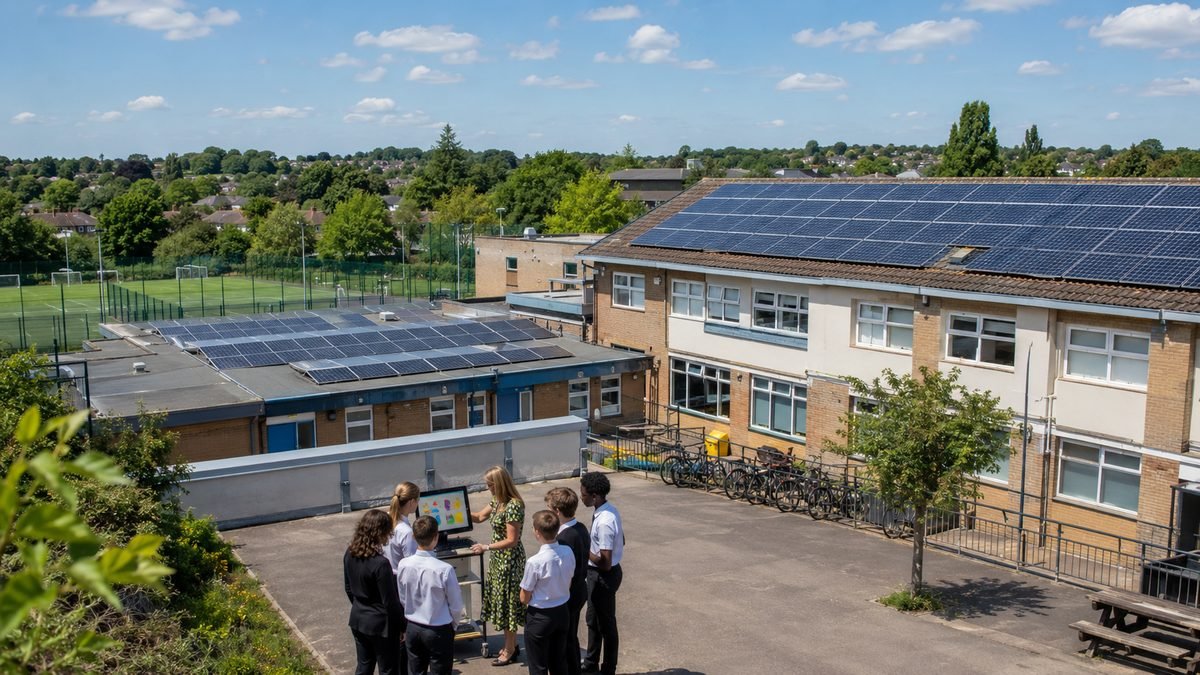
The government has announced that hundreds more schools and colleges in England will gain access to solar panels through a combination of public funding and a new private-finance pilot. One hundred additional sites will join the Great British Energy Solar Partnership with backing of up to £40 million. A further 150 schools and colleges in Yorkshire and the Humber, the East Midlands and the South East will test a model in which private companies install, own and maintain panels without an upfront payment from the education provider.
The expansion builds on installations at 245 schools and colleges. Ministers estimate that the first wave will save a combined £220 million over the lifetime of the panels. They say secondary schools that received solar and LED lighting upgrades are saving an average of £58,600 a year, while primary schools are saving £21,000. These are government figures and outcomes will vary by roof size, electricity use, tariff and system performance.
Why energy bills matter to school budgets
Energy is a substantial and sometimes volatile cost for schools. A sudden increase in electricity or gas prices can divert money from teaching materials, support staff, maintenance and enrichment. Unlike many businesses, schools cannot simply reduce opening hours, pass costs to customers or choose whether to heat occupied buildings. They also manage older estates with uneven insulation, complex roofs and equipment that may be inefficient.
Solar generation can reduce the amount of electricity purchased from the grid during daylight hours. That profile can suit schools because much of their activity occurs during the day. Savings are strongest when a site uses the power as it is generated rather than exporting large amounts at a lower price. Colleges with workshops, kitchens, laboratories or year-round use may have particularly consistent daytime demand.
How the publicly funded scheme works
Under the government-backed partnership, capital funding pays for approved installations, allowing participating schools to receive the benefit without financing the equipment from already stretched budgets. The practical process includes roof surveys, structural checks, grid connection, procurement, installation and monitoring. Not every building will be suitable. Roof condition, shading, orientation, heritage constraints and planned redevelopment can all affect whether solar is technically and financially sensible.
Combining panels with LED lighting and energy-management improvements can deliver broader savings than generation alone. Efficient lighting reduces electricity use in all seasons, while controls can identify waste and help staff understand consumption. The strongest projects are therefore likely to treat solar as part of an estate strategy rather than a decorative sustainability measure. Maintenance plans, warranties and clear responsibility for repairs are essential over systems designed to operate for decades.
The private-finance pilot and its trade-offs
The private model is designed to remove upfront cost. An investor funds, installs, owns and maintains the panels, while the school buys the electricity they produce at a rate intended to be lower than its normal tariff. Arrangements of this kind can accelerate deployment because public capital is limited. They transfer some performance and maintenance risk to a specialist provider and may give schools more predictable energy costs.
However, long contracts require careful scrutiny. Schools need to understand price-indexation clauses, roof-access rights, what happens during building work, equipment-removal obligations and the treatment of surplus generation. A cheap starting tariff is not enough if later increases are poorly controlled. Procurement must protect schools from unsuitable providers and ensure that educational estates are not tied into agreements that complicate future repairs or redevelopment. The pilot is intended to inform a wider national rollout from 2027-28.
Environmental and educational benefits
Solar panels can lower operational carbon emissions when they displace grid electricity, although the precise benefit depends on the changing carbon intensity of the power system. They also make clean-energy infrastructure visible to pupils. Real-time generation displays can support lessons in physics, geography, computing, economics and climate science. Students can compare weather, demand and output, turning the building into a practical learning resource.
There is also a community dimension. Schools are prominent public buildings, and successful projects can demonstrate technology to families who may never have seen a large installation closely. Yet claims should remain realistic. Solar will not eliminate all energy bills, power every school continuously or solve problems such as poor insulation and ageing heating systems. It is one component of a broader transition that may also require heat pumps, fabric improvements, storage and changes to how buildings are operated.
What success should look like
The programme should be judged by verified savings, reliable equipment and the amount of money genuinely redirected to education. Published case studies need to show baseline consumption, generation, contract terms and maintenance costs so that headline estimates can be tested. The distribution of projects matters too: schools in deprived areas or with inefficient estates should not lose out because they have less capacity to manage complex applications.
If the pilots work, the ambition is for every school and college in England eventually to be able to access solar. Reaching that scale would require a capable installer workforce, strong quality assurance, grid coordination and standard contracts that protect public institutions. Today's announcement is therefore both an energy project and an experiment in financing public infrastructure. Its promise is straightforward: lower bills, cleaner electricity and more money for pupils. Delivering that promise will depend on the details of installation and long-term governance.
Sources & verification
- UK Government - Hundreds more schools join solar drive
- Great British Energy
Filed under UK News · Written by Eleanor Whitfield