Europe's leaders back Zelenskyy's call for direct talks as Putin rebuffs summit
Britain, France and Germany endorsed Ukraine's push for face-to-face ceasefire negotiations after a London meeting, but the Kremlin dismissed the proposal as fighting continued on the front lines.
Marcus Reeve
Writer ·
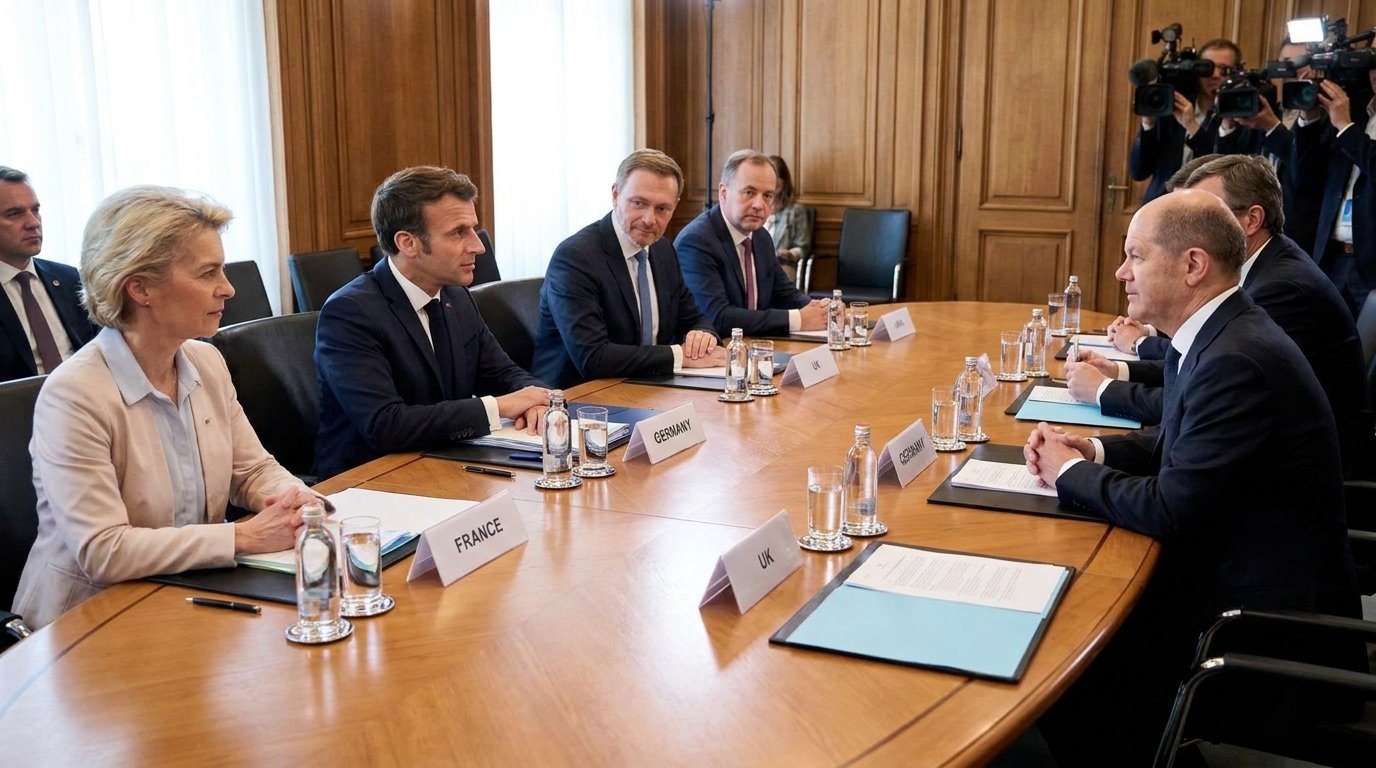
Ukrainian President Volodymyr Zelenskyy won fresh backing from Europe's leading powers this week for his push to open direct ceasefire negotiations with Moscow, even as Russian President Vladimir Putin dismissed the prospect of a summit and the two armies traded fire across the front lines.
Meeting in London on 7 June with UK Prime Minister Keir Starmer, French President Emmanuel Macron and German Chancellor Friedrich Merz, Zelenskyy secured a joint statement from the so-called E3 commending his peace proposal and his call for face-to-face talks involving active US and European participation. The choreography of the meeting was itself a message, intended to demonstrate that Europe's largest economies remain aligned behind Kyiv after more than three years of war.
The London gathering came at a delicate moment, with Ukraine seeking to keep its Western partners united while testing whether any diplomatic opening exists. For European leaders, the visit offered a chance to reaffirm support without committing to terms that Kyiv has not itself accepted.
Kremlin sees no purpose in a meeting
Zelenskyy had offered on 5 June to meet Putin in person, declaring he was ready for a full ceasefire. The Russian leader rejected the overture, saying he saw no purpose in such a meeting at this time. Russian officials have repeatedly insisted that any settlement must reflect what they describe as the situation on the ground, language Kyiv interprets as a demand to ratify territorial gains made by force.
After the London talks, Zelenskyy stressed the importance of ensuring that Europe's voice in any negotiations remained strong, reflecting Ukrainian concern that a deal could be shaped over its head by larger powers. The Ukrainian leader has long argued that lasting peace requires firm security guarantees, not merely a pause in the fighting that Russia could use to regroup.
“Europe's position and voice in the negotiations must be strong.”
— Volodymyr Zelenskyy, President of Ukraine
Diplomats acknowledged that the gap between the two sides remains wide. While Kyiv frames a ceasefire as a first step toward broader talks, Moscow has signalled that it wants core political questions settled before agreeing to halt combat operations, a sequencing dispute that has repeatedly stalled earlier efforts.
Fighting continues on multiple fronts
The diplomacy unfolded against a backdrop of continued violence. Russian drone and artillery strikes killed five people in Ukraine's Zaporizhia region, while Ukrainian forces struck targets in Crimea and inside Russia, including energy infrastructure in Volgograd and a loading complex at the Black Sea port of Novorossiysk. Both sides have increasingly relied on long-range drones to hit logistics, refineries and ports far from the contact line.
Ukraine's deep strikes against Russian energy facilities are part of a strategy to raise the economic cost of the war and disrupt the supply chains that sustain Moscow's military. Russia, in turn, has continued to target Ukrainian cities, power generation and grain export infrastructure, keeping civilians under sustained threat.
The principal points of contention between the two sides include:
- The sequencing of a ceasefire versus a comprehensive political settlement
- The status of Ukrainian territory currently under Russian control
- Security guarantees for Ukraine and the role of Western partners in providing them
- The format of any talks and whether Putin and Zelenskyy would meet directly
- The degree of US and European involvement in shaping and underwriting a deal
Background to the diplomatic push
Russia's full-scale invasion of Ukraine began in February 2022 and has since become the largest land conflict in Europe since the Second World War, displacing millions and reshaping the continent's security architecture. Repeated mediation attempts, including talks hosted by third countries, have failed to produce a durable halt to the fighting, though prisoner exchanges and limited humanitarian arrangements have at times been negotiated.
The E3 format brings together Britain, France and Germany, three of Europe's most influential military and diplomatic actors, and has become a key vehicle for coordinating support to Ukraine. Their endorsement carries weight in Western capitals, but it does not by itself bring Moscow to the table, underscoring the limits of European leverage when Russia perceives advantages in continuing to fight.
Analysts caution that diplomatic momentum can shift quickly, and that even a rebuffed offer can serve a purpose by signalling intentions and shaping the position of allies. By placing the proposal on the table in London, Kyiv sought to demonstrate flexibility while putting the onus for any breakdown on Moscow.
What happens next
With the Kremlin having rebuffed a summit, the immediate prospects for direct talks appear slim, and the conflict is likely to remain dominated by attritional fighting and long-range strikes in the near term. Much will depend on whether Washington and European capitals can craft an offer that Moscow regards as serious, and on developments on the battlefield, which continue to shape each side's willingness to negotiate. For Kyiv, the priority is to keep its partners united and to ensure that any future settlement is one Ukraine helps to write rather than one imposed upon it.
Sources: reporting by Al Jazeera.
The NE Times is an independent news and analysis publisher. Our articles combine factual reporting with clearly-written, impartial analysis. Content is for general information and does not constitute professional advice. Disclaimer.
You may also like to read
Kyiv warns its ceasefire patience is not endless as war passes grim milestone
Ukraine has signalled that its offer of a full and unconditional ceasefire may not stay on the table indefinitely, raising the pressure on diplomacy and on Moscow's response.
European Leaders Prepare Strong Ukraine Message Before NATO Summit
European allies aim to signal renewed unity on Ukraine ahead of the NATO summit in Ankara, as Trump praises Zelenskyy's resilience against Russia.
Ukraine says long-range strikes hit Russian gas plant and satellite sites
Kyiv widens its campaign against infrastructure it describes as supporting Moscow's war effort, targeting energy and space-linked facilities.
Ukraine Says Russia Is Shifting Air Defences After Drone Strikes
Kyiv claims Moscow is redeploying systems towards the capital, Valdai and the Kerch Bridge, citing the strain caused by its long-range strike campaign.