Ships as launchpads: the shadow-fleet report that widens Europe's drone problem
An IISS assessment reported by AP suggests Russia likely used shadow-fleet vessels to launch drones over Europe, turning an airspace issue into a maritime one.
Marcus Reeve
Writer ·
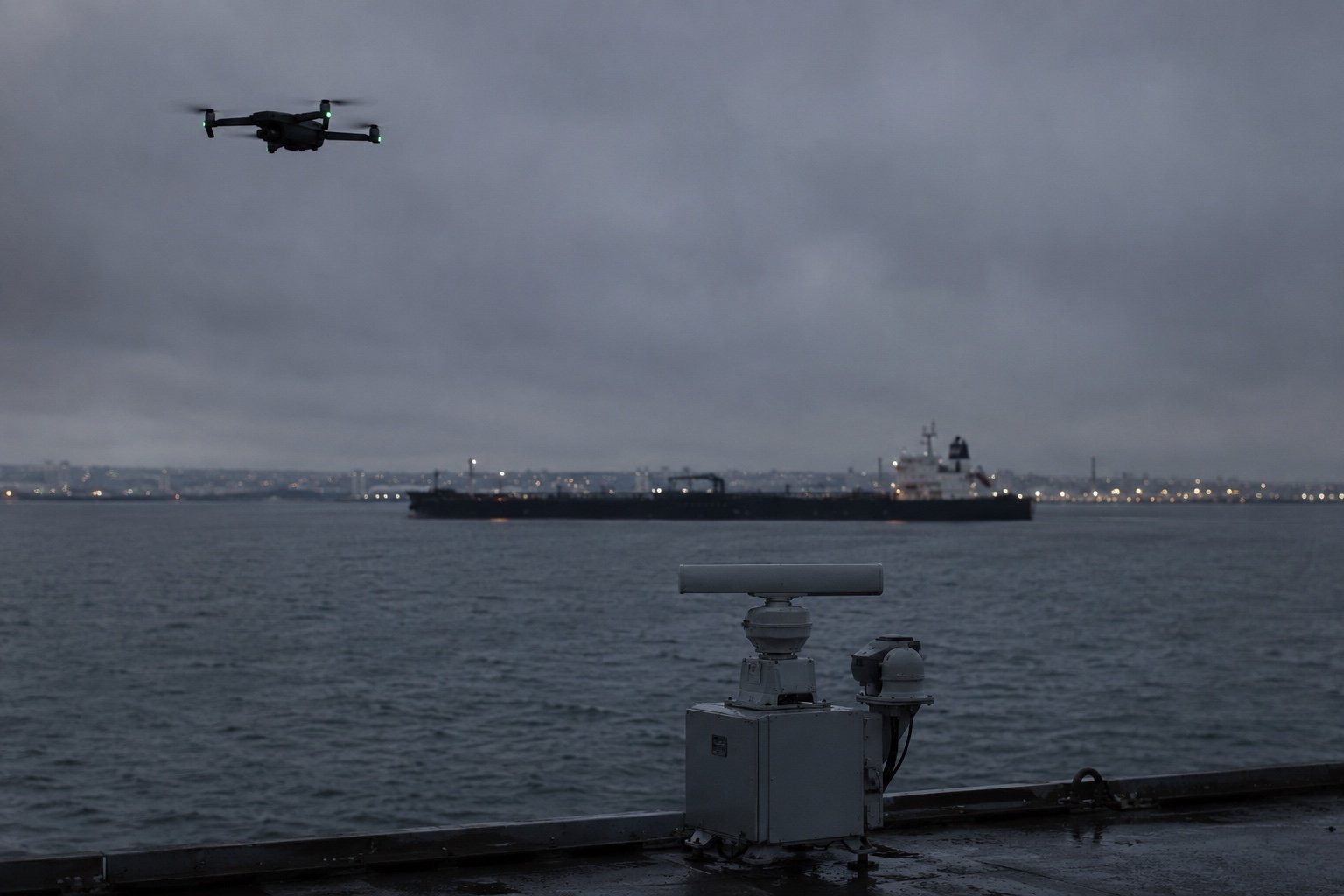
For years Europe's drone-security debate has been framed as an airspace question: how to spot small aircraft, protect airports and decide when to shoot. New reporting has redrawn that map. If drones can be launched from ships of murky ownership loitering off European coasts, then the continent's air-defence problem is also a ports, sanctions and maritime-surveillance problem.
What happened
The Associated Press reported on an International Institute for Strategic Studies assessment which concluded it is highly likely that Russia used vessels from its so-called shadow fleet as platforms for some drone launches over Europe. The IISS plotted 144 suspected sightings between 2024 and 2026 — including over Germany, France, Belgium, the Netherlands, the UK and Denmark — with a peak in late 2025 that forced temporary airport closures. AP cited vessel movements such as the tanker Boracay, which drew attention after drone flights over Denmark, and the Vezhen, which sailed in circles off Ireland during a visit by Ukraine's president.
Why it matters
Drones are useful precisely because they are ambiguous. They fly low and slow, can read on radar like birds, and even when downed are hard to attribute. That makes them political instruments as much as physical ones — generating cost, disruption and unease while staying below any threshold that might trigger a collective NATO response. Add a launch platform that looks like an ordinary tanker, and the same opaque maritime networks that frustrate sanctions enforcement begin to frustrate air defence too.
The counter-view
The caution in the reporting deserves as much weight as the findings. Several senior European officials told AP that attribution remains genuinely difficult, and NATO's deputy supreme allied commander in Europe, Air Chief Marshal John Stringer, declined to blame Moscow directly — even while noting the activity fits a pattern of disruption Western officials have attributed to Russia since 2022. Vladimir Putin has denied that Russia is waging a sabotage campaign against Europe. Overstatement here would be as corrosive as complacency: not every sighting has been attributed, and the report did not examine incursions along NATO's eastern flank. The structural weakness the report exposes is fragmentation. As Sweden's military representative to NATO told AP, counter-drone responsibility is split across airport operators, police, coastguards, intelligence services and militaries — and interception decisions are fraught, because bringing a drone down near an airport can itself endanger civilians. When the launch point is at sea, the chain of responsibility grows longer still.
What happens next
Denmark and several other countries have already said they will strengthen drone defences, and the likely response involves layers: better sensors around airports and bases, clearer interception rules, tighter tracking of suspicious vessels and faster civil-military information sharing. The harder task is coherence — building a system that treats small, ambiguous, repeated events seriously without either panicking or normalising them. The report's real lesson is that modern threats rarely stay in the category where governments first file them.
Sources: reporting by Associated Press.
The NE Times is an independent news and analysis publisher. Our articles combine factual reporting with clearly-written, impartial analysis. Content is for general information and does not constitute professional advice. Disclaimer.
You may also like to read
European Leaders Prepare Strong Ukraine Message Before NATO Summit
European allies aim to signal renewed unity on Ukraine ahead of the NATO summit in Ankara, as Trump praises Zelenskyy's resilience against Russia.
On Gotland, Baltic security has stopped being abstract
Sweden's remilitarisation of Gotland — 275km from Kaliningrad — shows European defence moving from theory into conscription, resilience and daily life.

NATO diplomacy tested by Iran war fallout
Summit preparations and senior officials' remarks place defence spending, Middle East instability and transatlantic cohesion under the same spotlight.

Ukraine says long-range strikes hit Russian gas plant and satellite sites
Kyiv widens its campaign against infrastructure it describes as supporting Moscow's war effort, targeting energy and space-linked facilities.