Southern Europe's wildfires are stress-testing the continent, not just its firefighters
Simultaneous blazes in Portugal, Greece and Spain — 12,000 hectares burned near Vouzela, toxic smoke near Thessaloniki — test Europe's shared capacity.
Marcus Reeve
Writer ·
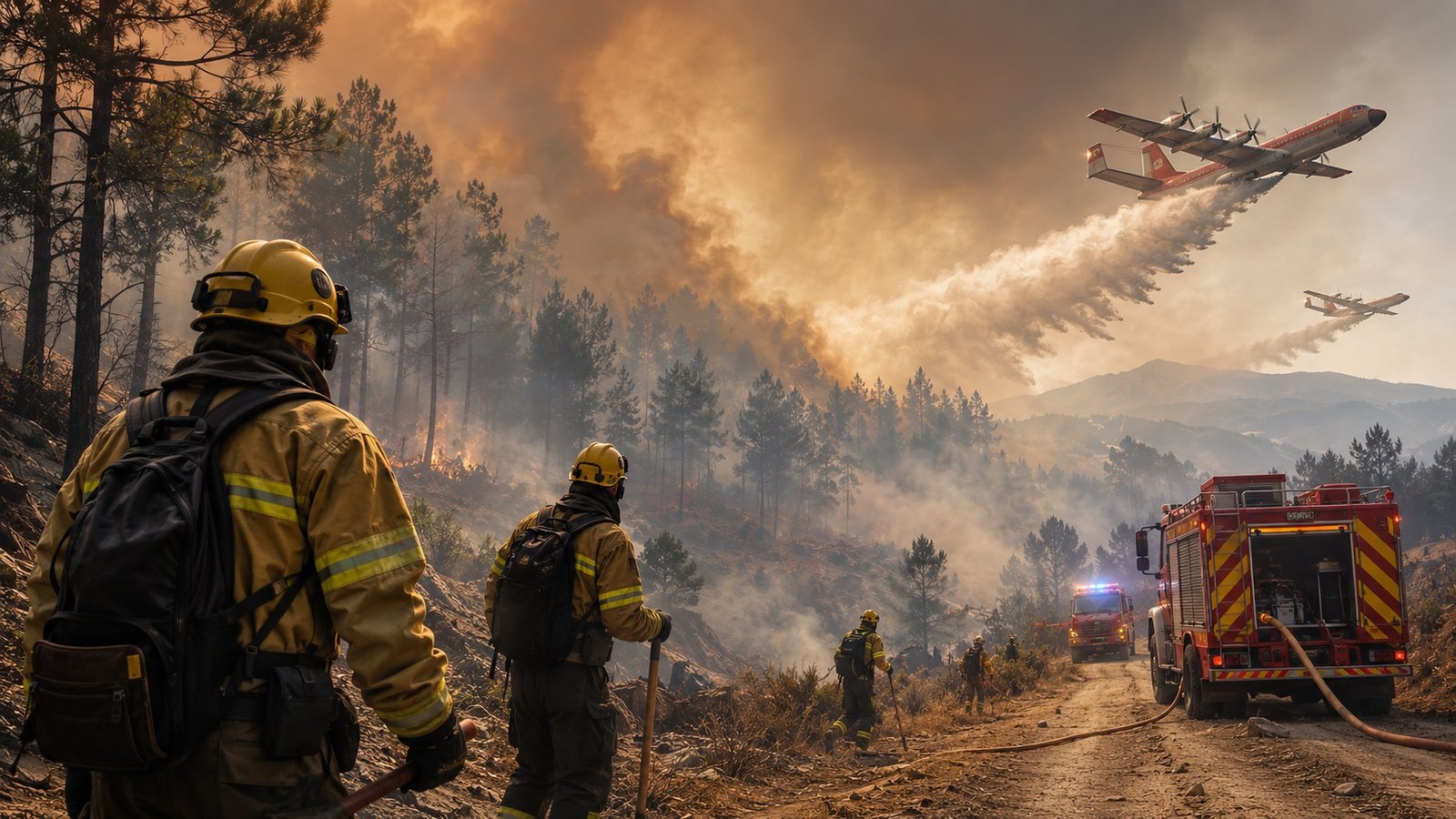
Wildfires burning across Portugal, Greece and Spain on Sunday produced a familiar summer image. The details underneath it point to something more structural: emergency systems in several countries being tested at once, and a continent discovering how far its shared capacity stretches.
What happened
The Associated Press reported that the fire near Vouzela in Portugal had burned across 12,000 hectares by Sunday, with more than 1,200 firefighters, nearly 400 vehicles and 15 aircraft engaged. Spain sent 120 firefighters and 45 vehicles, and aircraft from Italy and Spain were dispatched under European civil-protection arrangements. In Greece, authorities warned residents near Thessaloniki to stay indoors because of toxic smoke from a recycling plant engulfed by wildfire, while 210 firefighters, volunteers and 29 aircraft tackled a separate blaze in pine forest near Mandra, west of Athens. Spain, meanwhile, fought its own fires even as it lent help abroad.
Why it matters
The decisive questions in a modern wildfire are operational rather than pictorial. Are roads open for engines and evacuations? Can aircraft fly before smoke, wind or nightfall closes the window — the deadline that arrives every evening? Are rural residents getting timely alerts, and are hospitals ready for smoke-related illness? The Thessaloniki warning shows how quickly a forest fire becomes an air-quality and public-health event once it reaches industrial sites. And Spain's dual role — sending crews abroad while burning at home — captures the central strain: solidarity is essential, but every country lending aircraft must preserve capacity for its own risk. When fires ignite simultaneously across borders, the system becomes a triage exercise in who needs scarce aerial assets most.
The bigger picture
The cross-border response in Portugal is the visible layer of a system built long before the emergency — agreements, drills, compatible command structures and institutional trust. It is also a reminder that Europe cannot file wildfire under 'southern, rural problem'. Smoke moves into cities; industrial sites burn; tourism, insurance, agriculture and energy all take hits far from the ignition point. Hotter, drier conditions are worsening risk across many landscapes, but each fire also has local causes, terrain and preparedness issues — the current emergency should not be flattened into a single explanation. Its significance lies in the combination: dry vegetation, wind, exposed settlements, limited aircraft hours and crews already accumulating fatigue with the season barely begun.
What happens next
The immediate priority is containment and public safety, and the response so far shows scale, professionalism and genuine international support. The longer-term challenge is harder: building systems that can absorb simultaneous shocks without depending on luck, exhaustion or last-minute improvisation. Wildfire seasons now test planning departments, health officials and communications teams as much as firefighters. When several countries need help at once, resilience stops being a national virtue and becomes a continental requirement.
Sources: reporting by Associated Press.
The NE Times is an independent news and analysis publisher. Our articles combine factual reporting with clearly-written, impartial analysis. Content is for general information and does not constitute professional advice. Disclaimer.
You may also like to read
Venezuelans search the rubble after powerful twin earthquakes kill scores
Rescue teams race through collapsed buildings in Caracas and along the coast as the death toll climbs, hospitals overflow with the injured and the government scrambles to coordinate relief.
Pope Leo XIV honours migrants who died at sea on first papal visit to the Canary Islands
Closing a week-long trip to Spain, Pope Leo XIV laid a floral tribute to those lost on the Atlantic crossing and urged Europe not to grow numb to deaths at sea.

Ronaldo answers critics with double in Portugal's 5-0 rout of Uzbekistan
Cristiano Ronaldo becomes the first player to score in six men's World Cups and hits back at a hostile week as Portugal revive their group campaign.

Spain make statement with 4-0 win over Saudi Arabia as Yamal shines
Lamine Yamal inspires a fast start as the European champions answer an opening draw, strengthening their case as World Cup favourites.