Cambridge's AI-designed 'universal' coronavirus vaccine passes its first human test
A jab whose active ingredient was created by computer rather than copied from a real virus has cleared its first safety trial, raising hopes of a vaccine that could blunt the next pandemic before it begins.
Eleanor Whitfield
Writer ·
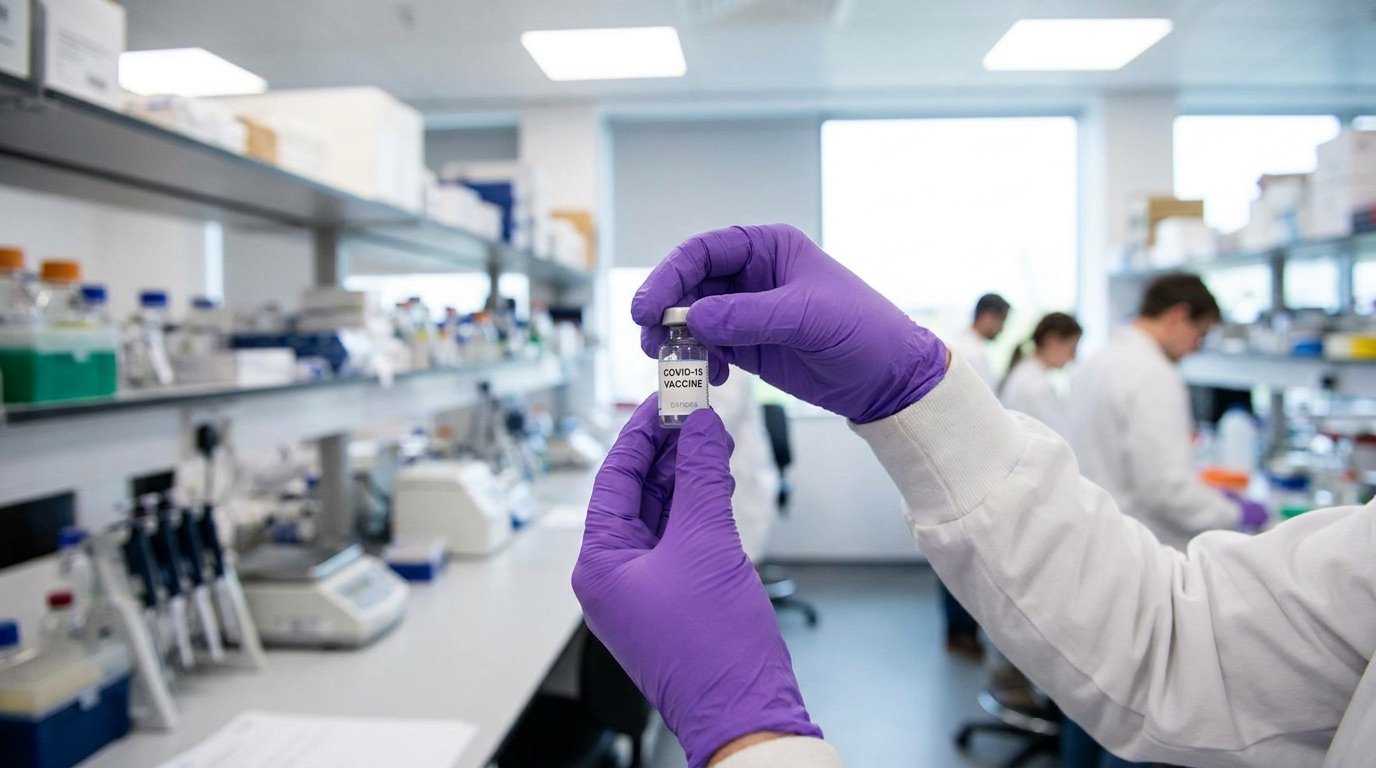
A vaccine whose active component was designed not by studying a real virus but by computer simulation has passed its first test in humans, in a result British researchers say could change the way the world prepares for future pandemics.
The experimental jab, developed by scientists at the University of Cambridge and the university spin-out DIOSynVax, was given to 39 healthy adult volunteers in an early-stage trial. It produced no serious side effects at any of the four doses tested and triggered immune responses against a broad family of coronaviruses, the team reported in the Journal of Infection in June 2026.
Unlike conventional vaccines, which are tailored to a single circulating strain, the Cambridge candidate is built to recognise an entire family of related viruses at once. Researchers say that breadth is precisely what is needed to respond faster the next time a dangerous pathogen jumps from animals to people.
A vaccine designed inside a computer
The candidate, known as pEVAC-PS, is described as a pan-Sarbecovirus vaccine. The Sarbecovirus group includes SARS-CoV-2, the virus that caused the Covid-19 pandemic, the original SARS coronavirus, and a number of related bat viruses that scientists fear could spill over into humans in the years ahead.
Rather than basing the vaccine on any one of those viruses, the team used machine-learning and computer modelling to design a synthetic 'super-antigen' that captures features shared across the whole family. The aim is to coax the immune system into recognising the common threads that bind these viruses together, rather than the surface details that change from strain to strain.
DIOSynVax, whose name stands for Digitally Immune Optimised Synthetic Vaccines, was founded in 2017 as a Cambridge spin-out with support from the university's commercialisation arm, Cambridge Enterprise. The phase one trial offers the first solid evidence that its computational design platform can produce a safe, workable vaccine in real people.
What the trial showed
In the study, the vaccine was delivered without a needle, using an intradermal DNA delivery method that places the genetic instructions just under the skin. Across all four dose levels tested, researchers recorded no serious adverse events, and volunteers mounted immune responses against several members of the coronavirus family.
The researchers stress that this was a first-in-human safety study, not proof that the vaccine prevents disease. Demonstrating real-world protection will require larger trials that follow many more people over a longer period. But the early data clears an important hurdle for a technology that had until now been tested mainly in the laboratory.
- 39 healthy adult volunteers took part in the phase one trial
- No serious side effects were recorded at any of the four doses
- The vaccine was delivered needle-free, under the skin
- It is designed to protect against SARS-CoV-2, SARS and related bat coronaviruses
- Results were published in the Journal of Infection in June 2026
Why breadth matters
Public health experts have long warned that the world's pandemic defences are reactive: a new virus emerges, and only then do laboratories race to develop a matching vaccine. A jab designed in advance to cover a whole viral family could shorten that race dramatically.
“The goal is to be ready before the next outbreak arrives, not to start from scratch once it is already spreading.”
If the approach proves durable, the same computational design method could in principle be pointed at other dangerous virus families, from influenza to the filoviruses that cause haemorrhagic fevers.
Background
Britain emerged from the Covid-19 pandemic with a strengthened reputation in vaccine science, built on the Oxford-AstraZeneca jab and a network of university spin-outs. The Cambridge result fits a wider push to use artificial intelligence and computational biology to speed up drug and vaccine discovery, an area where ministers have promised continued investment.
Cambridge Enterprise and the university have framed the work as an example of how publicly funded research can mature into commercial products that serve both patients and the wider economy, at a time when university research budgets are under intense strain.
What happens next
The team now needs to move into larger, later-stage trials to test whether the vaccine actually protects against infection and how long any protection lasts. Securing the funding and manufacturing capacity to do that at scale will be the next test, but for now researchers say they have shown that a vaccine conceived inside a computer can be made, given safely and recognised by the human immune system.
Sources: reporting by University of Cambridge.
The NE Times is an independent news and analysis publisher. Our articles combine factual reporting with clearly-written, impartial analysis. Content is for general information and does not constitute professional advice. Disclaimer.
You may also like to read
Parents back tougher screen rules as children embrace AI, polling shows
New government polling reveals strong public support for limits on young children's screen time and a possible social media ban for under-16s, even as surveys find a majority of children already using AI every day.

Ministers move to close the AI chatbot loophole in online safety law
The government is fast-tracking reforms to bring standalone AI chatbots within the scope of online safety rules, after an Ofcom investigation exposed a gap that left some tools outside the law entirely.

RAISE US launches with $500m to retrain workers for the AI economy
A bipartisan nonprofit founded by Gina Raimondo and Eric Holcomb plans to work with states and employers on education and retraining.
UN presses AI companies to disclose environmental impact and go renewable by 2030
Secretary-general Antonio Guterres calls on artificial intelligence firms to reveal data-centre energy and water use, putting AI's climate footprint under fresh scrutiny.