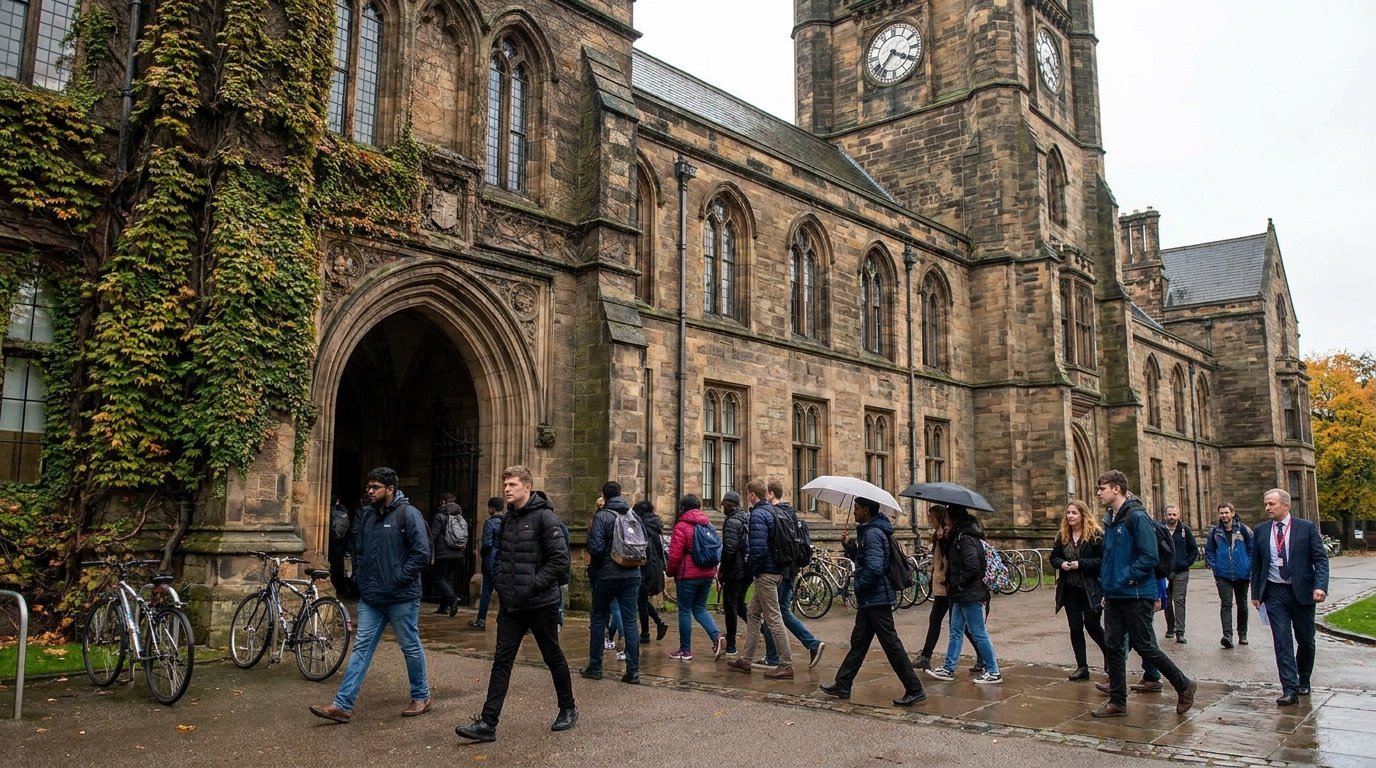
Universities in Turmoil as Job Cuts Mount and Watchdog Warns of Closures
The Office for Students has identified two dozen providers at immediate risk of halting degree courses, with more than 5,000 redundancies announced across the sector and almost half of institutions projected to run a deficit this year.
UK News & Politics Editor ·
Why it's trending
24 providers are at immediate risk of halting courses, 5,000+ redundancies are announced, and nearly half the sector is in deficit.
The financial crisis in English higher education has stopped being a forecast and become a headcount. More than 5,000 redundancies have been announced across the sector since 2025 — on top of over 12,000 university jobs cut in 2025 alone — and the Office for Students has identified 24 providers at immediate risk of halting degree courses within twelve months. Times Higher Education's rolling tally of cuts reads like a map of the sector.
The underlying arithmetic is unforgiving: around 45% of providers are projected to run deficits in 2025-26, and two in five institutions are considering mergers. The question has shifted from whether the sector shrinks to how — and who manages the shrinkage.
At a glance
- Around 45 per cent of providers projected to run a deficit in 2025-26
- 24 providers at immediate risk of halting courses within 12 months
- More than 5,000 redundancies announced since 2025
- Over 12,000 university jobs cut in 2025 alone
- Two in five institutions considering mergers
How universities got here
Three revenue engines stalled at once. Domestic fees were frozen for the best part of a decade while costs inflated; international enrolments — the cross-subsidy that hid the domestic loss — fell as visa rules tightened and competitor countries recruited harder; and pension and pay pressures compounded on the cost side.
Institutions borrowed and built during the boom years on assumptions of perpetual growth. Campuses financed against student number projections that no longer materialise are now fixed costs in a shrinking-revenue world.
What 'risk of closure' actually means
The OfS's 24-provider warning is about market exit in a system with no orderly failure regime. Universities are autonomous charities and companies, not public bodies; no statutory mechanism exists to wind one down while protecting students mid-degree.
The regulator's concern is therefore practical: student protection plans, teach-out arrangements and records preservation. A disorderly collapse — students stranded mid-course — is the scenario every contingency plan exists to prevent, and the OfS has been explicit that it will not bail out failing institutions.
The human cost in departments
Redundancy programmes concentrate where student demand is weakest, which in practice means arts, humanities and languages departments closing across multiple institutions — a quiet reshaping of what English universities teach.
For staff, the sector's implicit bargain — modest pay for security and vocation — has broken. Morale, industrial disputes and the flight of early-career academics to other countries and careers are the visible symptoms of a workforce absorbing structural contraction.
Mergers: the managed path
With two in five institutions considering mergers, consolidation is the sector's least-bad tool: shared services, federated structures, full institutional combinations. Done early, mergers preserve provision under new badges; done in distress, they are rescues with all the asymmetry the word implies.
The obstacles are governance pride, brand attachment and the genuine complexity of combining institutions with different missions. Expect the language of 'strategic partnership' to do heavy lifting while the balance sheets drive the timetable.
What happens next
Fee indexation from 2026 stabilises domestic funding at the margin, but the OfS's next financial sustainability report — and the fate of the 24 flagged providers — will define the year. Ministers face the question they have deferred: whether any institution is too important to fail, and who pays if so.
For applicants and families, the practical advice is unglamorous: check an institution's financial health signals and student protection plan alongside its prospectus. The sector's promise of permanence can no longer be assumed.
Sources & verification
- Times Higher Education — primary reporting referenced by this article
Filed under UK News · Written by Eleanor Whitfield
You may also like to read