Votes at 16 bill returns to the Commons as election overhaul advances
The government's flagship democracy legislation, lowering the voting age and reshaping party funding rules, has been carried over into the new session.
Eleanor Whitfield
Writer ·
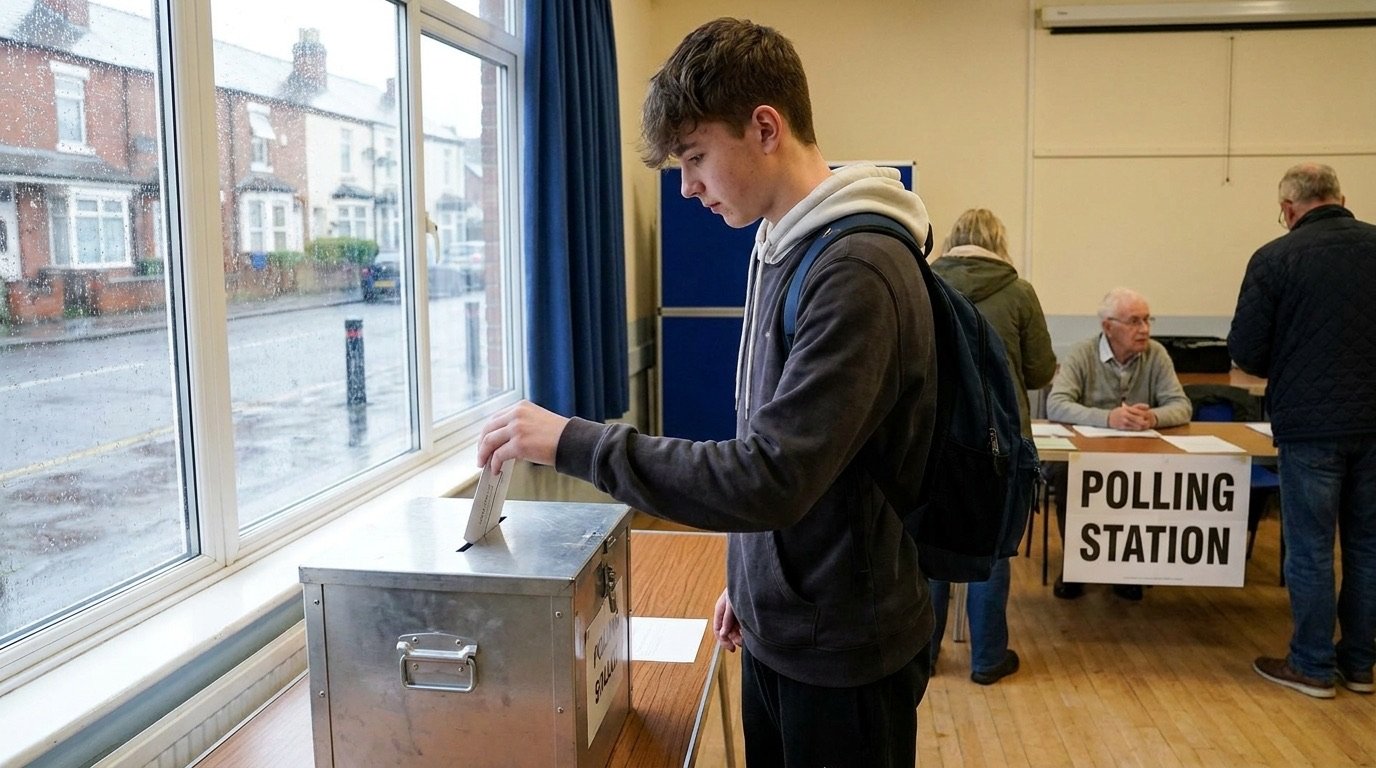
The government's Representation of the People Bill, which would lower the voting age to 16 across the United Kingdom, is making its way back through Parliament after being carried over into the new session. The legislation represents the most significant overhaul of how Britain runs its elections in a generation.
Beyond extending the franchise to 16 and 17-year-olds, the Bill contains a sweeping package of measures on voter registration, the conduct of elections and the rules governing political donations. Ministers argue that giving younger people the vote will strengthen democratic engagement and bring Westminster into line with Scotland and Wales.
The Bill is one of the government's flagship constitutional measures, and its progress is being watched closely by all parties because changes to the franchise and to funding rules can reshape the electoral battlefield itself. Supporters cast it as a long-overdue modernisation of the democratic process; opponents question both the motives behind it and the evidence for its central claims.
What the Bill contains
The most eye-catching provision is the lowering of the voting age, but the legislation ranges far wider. It addresses how voters get onto the electoral register, the conduct of polling and counting, and the framework of rules that governs how political parties raise and spend money. Taken together, the measures amount to a substantial rewrite of electoral law.
Among the principal elements of the Bill are the following:
- Lowering the voting age to 16 in all UK elections, extending the franchise to 16 and 17-year-olds across England and Northern Ireland as well as Scotland and Wales.
- Reforms to voter registration intended to make it easier for eligible people to get onto the electoral roll.
- Changes to the conduct of elections and the administration of polling.
- New rules governing political donations and party funding.
- Measures designed to improve the integrity and transparency of the electoral process.
Lowering the voting age would bring elections to Westminster and to local authorities in England into line with the rules already in place for the Scottish Parliament and the Senedd, where 16 and 17-year-olds have been able to vote for some time. Ministers say this inconsistency, under which a teenager can vote in some elections but not others, is difficult to justify.
“If you are old enough to work and pay taxes, you are old enough to have a say in who governs you.”
— A Cabinet Office spokesperson
A carried-over bill
The Bill was introduced in February and cleared its committee stage over nine sittings in the spring before the previous session ended without it completing its passage. As a carry-over measure it was given fresh first and second readings in the new session in May, and now awaits its report stage in the Commons before heading to the Lords.
Carry-over is a procedural device that allows a Bill to resume in a new parliamentary session from broadly the point it had reached, rather than starting again from scratch. It is used to prevent complex legislation from being lost simply because the parliamentary calendar has turned, and its use here reflects the government's determination to see the reforms through.
At report stage, the whole House has the opportunity to consider amendments to the Bill, and contentious provisions can be subjected to fresh votes. With the franchise change and the donation rules both attracting controversy, this stage is likely to be closely fought before the Bill moves to the Lords for detailed scrutiny.
The arguments for and against
The proposals remain contentious. Critics question whether lowering the voting age will deliver the promised boost in turnout and have raised concerns about safeguards around the new donation rules, setting the stage for further wrangling as it moves through its remaining stages. Some argue that 16 and 17-year-olds lack the maturity or independence to cast an informed vote, while others contend that the change is being pursued for partisan advantage.
An opposition spokesperson argued that the government had not made a convincing case that extending the franchise would strengthen democracy, and called for the donation provisions in particular to be examined far more closely. Supporters of the Bill respond that younger voters are directly affected by decisions on education, the climate and the economy, and that enfranchising them earlier is more likely to build a lasting habit of voting.
Background
Debate over the voting age has run for many years, gaining prominence after 16 and 17-year-olds were allowed to vote in the 2014 Scottish independence referendum. Scotland and Wales subsequently extended the franchise for their own devolved and local elections, creating a patchwork in which the voting age varies depending on the type of election. The current Bill is the government's attempt to resolve that inconsistency at UK level while bundling in a broader set of electoral reforms.
What happens next
Once the Bill completes its report stage and third reading in the Commons, it will pass to the House of Lords, where peers are expected to scrutinise the detail closely, particularly the provisions on party funding. Any amendments made by the Lords would return to the Commons, and the two Houses would need to reach agreement before the Bill could receive royal assent. Even after it becomes law, electoral administrators would need time to prepare before the changes take effect at the polls.
Sources: reporting by House of Commons Library.
The NE Times is an independent news and analysis publisher. Our articles combine factual reporting with clearly-written, impartial analysis. Content is for general information and does not constitute professional advice. Disclaimer.
You may also like to read

MPs warn ministers are not doing enough to tackle online misinformation
The Science, Innovation and Technology Committee has pressed the Technology Secretary over the spread of harmful content after fresh unrest linked to a fatal stabbing.

Shincheonji Church Leader Lee Man-hee Arrested in South Korea Election Probe
The 95-year-old founder was detained as authorities investigate claims that followers were recruited into a political party to sway elections.
Colombia's progressive candidate concedes presidential election
Ivan Cepeda concedes to Trump-endorsed outsider Abelardo de la Espriella after a runoff signalling a sharp political shift.

Colombia braces for a polarising runoff as Cepeda and de la Espriella battle for the presidency
A leftist heir to Gustavo Petro faces a self-styled hardline outsider in a 21 June second round that could reset Bogotá's ties with Washington and its approach to security.