Brexit anniversary revives debate over a faster UK route back to the EU
A decade on from the referendum, a former EU negotiator suggested Britain could rejoin on a short timeline if it chose to, while stressing that core EU rules would apply.
Eleanor Whitfield
Writer ·

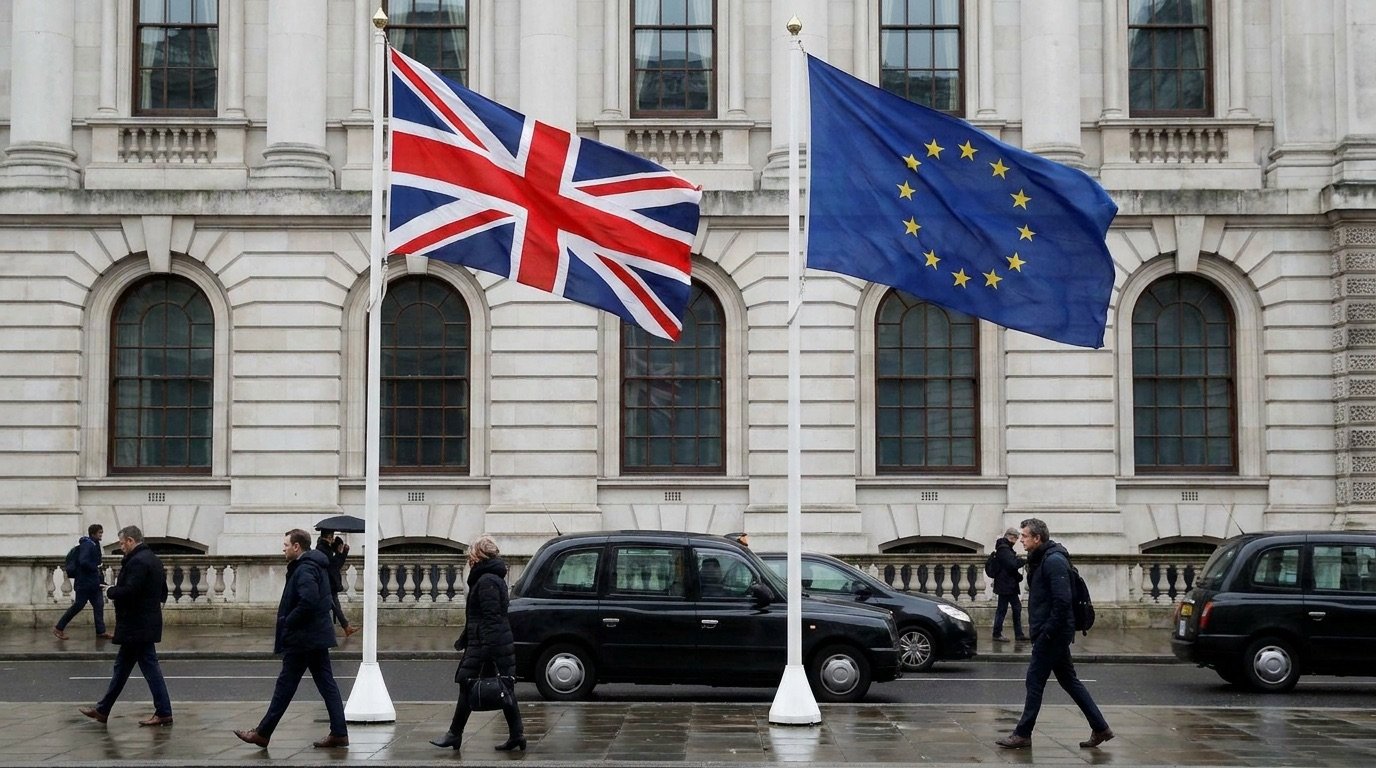
On the tenth anniversary of the Brexit referendum, a former EU negotiator has reignited debate by suggesting that the UK could rejoin the bloc on a relatively short timeline if it chose to, while stressing that core EU rules would have to apply. The intervention, captured in live coverage, has stirred a familiar argument back to life.
The comment landed within a wider conversation about shifting public opinion, the views of younger voters and the long economic legacy of leaving the EU. A decade on, the question of Britain's relationship with Europe remains unsettled.
The remark is less a prediction than a provocation, framing rejoining as a political choice rather than a practical impossibility, and inviting fresh scrutiny of where opinion now stands.
A negotiator's framing
By suggesting that re-entry could be achieved on a short timeline, the former negotiator shifts the debate from whether it is feasible to whether there is the political will. The caveat about core EU rules is a reminder that rejoining would mean accepting the bloc's terms.
- The comment marked the tenth anniversary of the Brexit referendum.
- A former EU negotiator said the UK could rejoin on a short timeline.
- He stressed that core EU rules would apply to any return.
- The remark fed into debate over public opinion and younger voters.
Opinion in flux
Attitudes towards Brexit have continued to evolve, with younger voters and the economic record both cited in the renewed discussion. The anniversary has provided a natural moment to take stock of how the country views the decision a decade on.
“The door is not bolted shut. The question is whether Britain chooses to walk back through it, on the EU's terms.”
Background
Any return to the EU would be a major undertaking, requiring negotiation, the acceptance of core rules and a domestic political mandate. Rejoining is not a simple reversal of departure, and the conditions attached would be central to any debate.
Ten years after the vote, the economic and political consequences of Brexit continue to be argued over, with supporters and critics drawing sharply different conclusions from the same period.
What happens next: the anniversary is likely to keep the question of the UK's relationship with Europe in the political foreground, even as any concrete move towards rejoining would depend on a shift in public opinion and political leadership.
Sources: reporting by The Guardian.
The NE Times is an independent news and analysis publisher. Our articles combine factual reporting with clearly-written, impartial analysis. Content is for general information and does not constitute professional advice. Disclaimer.
You may also like to read
Britain and EU set 22 July date for second summit as Starmer pushes 'reset' deeper
Sir Keir Starmer has agreed with European Council President Antonio Costa to hold a second UK-EU summit in Brussels on 22 July, with a youth mobility scheme expected to be among the headline outcomes.

UK-UAE Sudan Testimony Raises Questions For Ministers
A parliamentary committee is to hear claims that ministers prioritised ties with the UAE over stronger action on mass atrocities in Sudan.

Swinney seizes on Starmer exit to renew independence referendum demand
Scotland's First Minister called Sir Keir's resignation proof that the Westminster system is 'broken', arguing a fresh start is 'only possible with independence'.
Moldova's Prime Minister Resignation Tests a Pro-Western Government
Dorin Recean's resignation triggers a government reset that lands at the intersection of domestic reform, EU alignment and persistent regional pressure.