Queensland's mystery beach objects are a warning from the space economy
Six suspected pieces of space debris on Queensland beaches — possibly toxic 'space balls' — expose the gap between orbital ambition and accountability.
Marcus Reeve
Writer ·
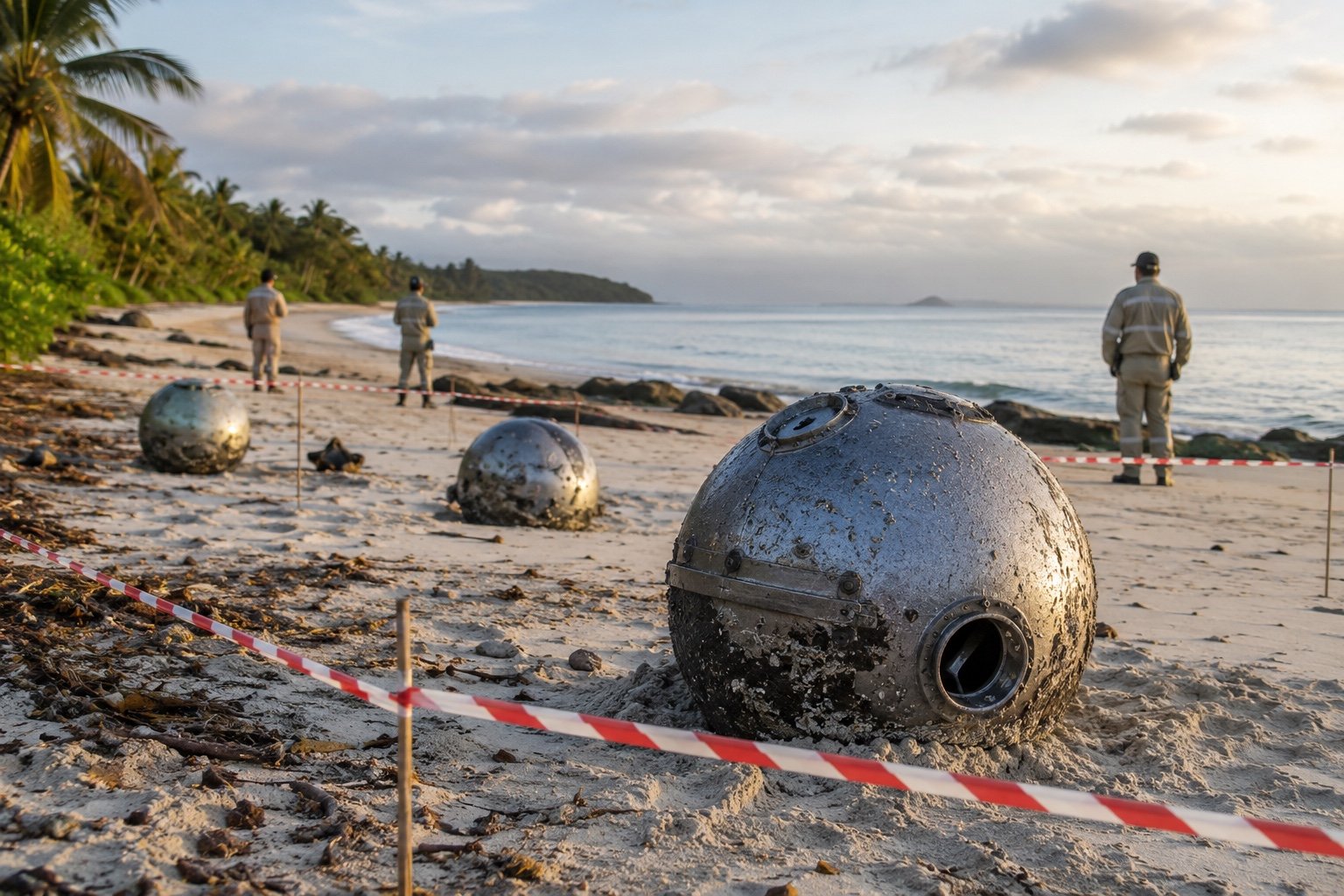
Strange metallic spheres on a beach, emergency crews in attendance and a local takeaway joking about a 'space junk snack box' — the discovery near Forrest Beach, north of Townsville, has all the trappings of a coastal curiosity piece. It is more serious than its oddness suggests, and more instructive too.
What happened
As the Guardian reported on 5 July, six suspected debris objects were found on beaches in the Forrest Beach area. Five had been secured in drums and a sixth was being rendered safe. Police said the objects were suspected of containing hazardous chemicals but stressed there was no danger to the local community and no criminal investigation. The Australian Space Agency is working with local authorities to identify the objects, and Queensland fire officials have warned that more debris could wash up in the coming days. Alice Gorman, the Flinders University space archaeologist, told the Guardian that footage suggested the objects may be pressurised fuel vessels from a rocket stage — informally known as 'space balls' — which could have contained residual hydrazine, a highly toxic rocket fuel, though she stressed a marine origin remained possible.
Why it matters
Space debris is usually imagined as an orbital problem — defunct satellites and fragments circling at speed. Re-entry converts orbital risk into ground risk. Most returning material falls into the ocean and never becomes news; when pieces land on populated coastlines, they expose the distance between the romance of space activity and the practical responsibilities attached to it. The immediate public-safety message is unglamorous but essential: do not touch unidentified debris. Hazardous residues, pressure systems and unknown contamination can make an inert-looking object genuinely dangerous.
The bigger picture
The space economy is expanding at pace — Gorman noted there have been more launches in the past five years than in all prior history — and more activity above Earth means more questions on it. If the Queensland objects are traced to a known launch, the public will reasonably ask who pays for clean-up, notification and risk management. International space law contains liability principles, but real cases turn on identification, cooperation and diplomacy. A beach find thus becomes part of a much larger evidentiary system: materials analysis, launch histories, orbital tracking and inter-agency coordination. Rocket hardware is not an abstract symbol of progress once it lands in an ecosystem or a community; routine launches will demand routine debris management.
What happens next
The objects may yet prove mundane — rocket stage, marine equipment or something else entirely — and the responsible position for now mirrors the authorities' caution: suspected space debris, origin undetermined, no current danger to residents. The wider lesson needs no such hedging. As launches accelerate, the world needs clearer public understanding of what comes back from orbit, how it is handled and who answers for it when it lands where people live. What falls back to Earth still belongs to the story of what was sent up.
Sources: reporting by The Guardian.
The NE Times is an independent news and analysis publisher. Our articles combine factual reporting with clearly-written, impartial analysis. Content is for general information and does not constitute professional advice. Disclaimer.
You may also like to read
When Confidentiality Feels Like a Gag: Australia's Parliamentary Watchdog Under Scrutiny
A staffer's account of jail-threat confidentiality warnings puts Australia's parliamentary complaints body — and workplace reform everywhere — to the test.
The Brooklyn Bridge Fire Shows What Civic Spectacle Really Depends On
A fireworks malfunction set the Brooklyn Bridge alight during America's 250th Independence Day show — a test of the invisible systems behind celebration.
At Mount Vernon, America's 250th birthday became a citizenship story
150 people from 50 countries took the oath of US citizenship at George Washington's estate on 4 July — giving the semiquincentennial a human scale.

In El Obeid, Sudan's drone war is measured in cancelled deliveries and closed roads
Reporting from the besieged Sudanese city shows how drone strikes are compounding displacement and shortages — and testing the limits of humanitarian work.