Thessaloniki wildfire turns evacuation planning into the main story
A fast-moving blaze near Greece's second city forced suburb alerts and the evacuation of 157 special-needs residents — a live test of readiness.
Marcus Reeve
Writer ·
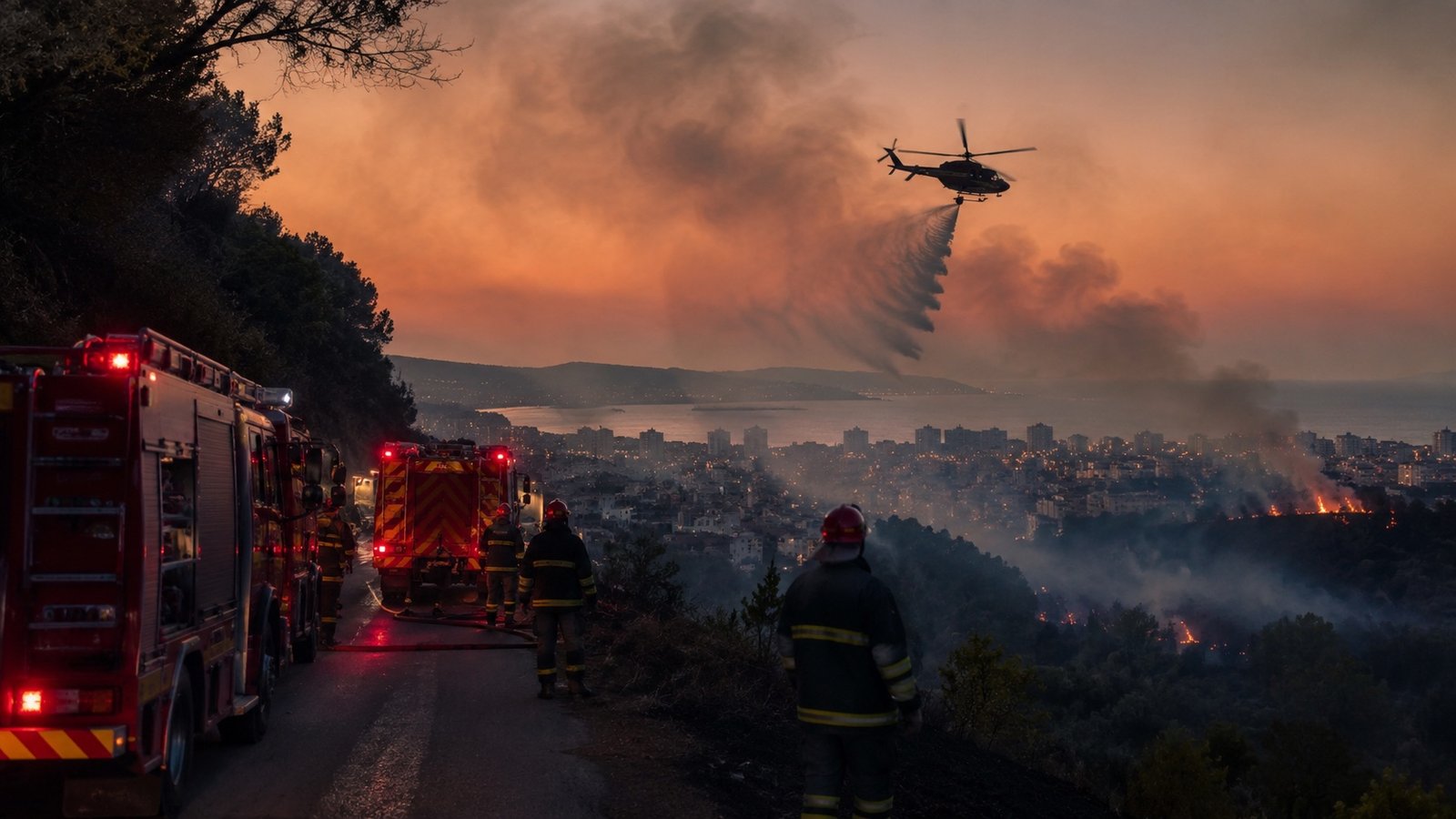
Wildfires are usually covered through images of flame and water-dropping aircraft. The blaze that broke out near Thessaloniki on Saturday evening deserves a different lens, because the most consequential work happened in the less cinematic spaces: evacuation alerts, transport for people who could not move themselves, and night operations after aircraft were grounded by darkness.
What happened
The Associated Press reported that the fire began around 8.30pm in a ravine north of Greece's second-largest city and spread quickly towards the plains, prompting evacuation alerts for Anthoupoli, Filothei and Galini. Several businesses were damaged and smoke drifted across western parts of the city, though homes were spared in initial reporting. A facility housing 157 people with special needs was evacuated — around 120 residents who could walk were moved to a gym, with others taken to a psychiatric hospital. About 115 firefighters, 38 engines and volunteers were deployed; aircraft joined briefly before nightfall ended flight operations. A 76-year-old man was arrested on suspicion of starting the blaze.
Why it matters
The special-needs evacuation is not a footnote; it is the detail that separates a real emergency plan from a theoretical one. Telling people to leave requires judging speed, route safety, who can move independently and where they will go. That some residents could be sheltered in a gym while others needed hospital care is exactly the kind of operational complexity that evacuation planning must anticipate in advance, not improvise at 9pm.
Timing compounded the difficulty. An evening ignition leaves emergency services minimal daylight: aerial support becomes impossible, visibility drops, and residents may be asleep or struggling to interpret shifting winds. Proximity to a major city changes the risk calculation too — a ravine fire becomes an urban emergency the moment wind, terrain and built-up areas align badly.
The bigger picture
Greece had largely escaped serious damage through June, before a central Greece fire earlier in the week killed a man and his 12-year-old son. Notably, the country has so far been spared the extreme heat gripping much of Europe — a reminder that wildfire danger is not simply a temperature reading. Dry vegetation, wind, terrain and ignition sources can produce a dangerous fire without a record heatwave attached.
What happens next
The near miss will be most valuable if it is treated as evidence. Residents need to know what a warning means and how to help neighbours who cannot move easily; authorities need shelter capacity and disability-aware transport ready before the next ignition. Across the Mediterranean's lengthening fire seasons, that choreography — not the flames — is the true measure of readiness.
Sources: reporting by Associated Press.
The NE Times is an independent news and analysis publisher. Our articles combine factual reporting with clearly-written, impartial analysis. Content is for general information and does not constitute professional advice. Disclaimer.
You may also like to read

When Confidentiality Feels Like a Gag: Australia's Parliamentary Watchdog Under Scrutiny
A staffer's account of jail-threat confidentiality warnings puts Australia's parliamentary complaints body — and workplace reform everywhere — to the test.
The Brooklyn Bridge Fire Shows What Civic Spectacle Really Depends On
A fireworks malfunction set the Brooklyn Bridge alight during America's 250th Independence Day show — a test of the invisible systems behind celebration.

At Mount Vernon, America's 250th birthday became a citizenship story
150 people from 50 countries took the oath of US citizenship at George Washington's estate on 4 July — giving the semiquincentennial a human scale.
In El Obeid, Sudan's drone war is measured in cancelled deliveries and closed roads
Reporting from the besieged Sudanese city shows how drone strikes are compounding displacement and shortages — and testing the limits of humanitarian work.