School Attendance Edges Up but Severe Absence Keeps Heads Awake
The latest figures show attendance in England's state schools has crept above 93 per cent this year, a slow recovery from the pandemic, yet persistent and severe absence remain stubbornly higher than before Covid, with secondaries lagging primaries.
UK News & Politics Editor ·
Why it's trending
Attendance has crept above 93% — but severe absence is still rising, and secondaries lag primaries badly.
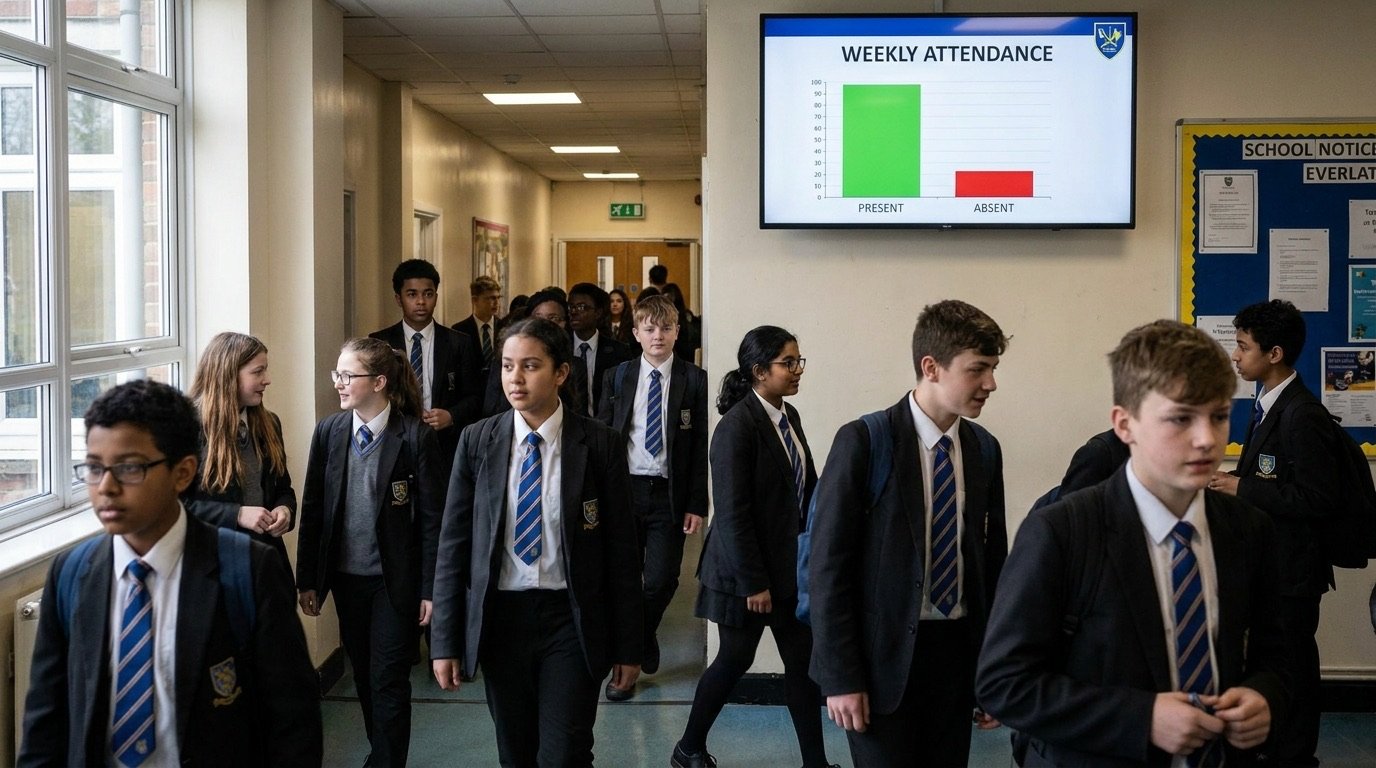
School attendance in England is recovering — slowly. Figures highlighted by the Children's Commissioner show overall attendance at 93.36% so far in 2025/26, a modest improvement that continues the grind back from the pandemic's disruption. Primary schools are leading the recovery at 94.6%, with secondaries trailing at 91.9%.
The celebration is muted for a reason. Absence before the pandemic ran at around 4.7%; it remains meaningfully higher now. Persistent absence — pupils missing at least one day a fortnight — has fallen to 1.28 million children, but severe absence, where pupils miss half their schooling or more, is still rising.
At a glance
- Overall attendance at 93.36 per cent so far in 2025/26
- Pre-pandemic absence was around 4.7 per cent
- Primary attendance 94.6 per cent, secondary 91.9 per cent
- Persistent absence down to 1.28 million pupils
- Severe absence continuing to rise
The post-Covid attendance settlement
Something changed in the relationship between families and school during the pandemic, and it has not fully changed back. The unwritten contract — children go to school every day unless genuinely ill — weakened during lockdowns, and rebuilding it has proved slower than anyone in the system expected.
The recovery is real but uneven: each year since 2021 has seen incremental improvement, driven by attendance hubs, data-sharing and relentless focus from heads. The 93.36% figure is progress; the pre-pandemic baseline remains the unmet benchmark.
Severe absence: the alarm inside the data
The figure that keeps head teachers awake is severe absence. A child missing more than half of school is usually a child whose life outside school has come apart — mental-health difficulties, unmet special educational needs, family crisis or unsuitable housing. Rising severe absence alongside improving averages means the recovery is leaving the most vulnerable behind.
These are also the children most exposed to exploitation and least visible to services. The Children's Commissioner has repeatedly linked severe absence to safeguarding risk, arguing that the register is one of the state's best early-warning systems — when someone reads it.
Why secondaries lag
The primary-secondary gap — 94.6% against 91.9% — is structural. Adolescence brings anxiety, peer difficulty and disaffection; secondary schools are larger and more anonymous; and older pupils can vote with their feet in ways infants cannot.
Friday absences, term-time holidays and the growth of part-time timetables all bite harder in secondaries. Closing the gap requires relational work — a trusted adult who notices — which is exactly what large schools find hardest to staff.
What the system is trying
The policy toolkit has expanded: daily attendance data flowing from school registers to the Department for Education, attendance mentors in high-absence areas, fines recalibrated for term-time holidays, and statutory guidance making attendance a whole-school priority rather than an office function.
The consistent lesson from improving schools is unfashionable: relationships beat enforcement. Schools that recover attendance fastest tend to treat absence as a symptom to be understood — then act on what they find, from uniform costs to unassessed needs.
What happens next
The full-year figures will confirm whether 2025/26 sustains the recovery and — the harder test — whether severe absence finally turns downward.
The strategic question hangs over the system: is the country converging back to the old normal, or settling permanently a notch below it? The answer, teachers point out, is being decided family by family, register by register, every morning.
Sources & verification
- Children's Commissioner for England — primary reporting referenced by this article
Filed under UK News · Written by Eleanor Whitfield
You may also like to read