British Steel Nationalised: What Public Ownership Means for Jobs, Scunthorpe and UK Industry
British Steel has entered public ownership to protect the Scunthorpe blast furnaces. What nationalisation means for jobs, taxpayers, green steel and UK industry.
Business & Technology Editor ·
Why it's trending
British Steel entering public ownership is the biggest UK industrial story of the day, with direct consequences for thousands of jobs, taxpayers and the future of domestic steelmaking.
A historic intervention in British industry
British Steel has formally entered public ownership after the government concluded that nationalisation was necessary to protect domestic steelmaking, strategic supply chains and thousands of jobs. The transfer took effect on 16 July 2026, one day after the Steel Industry (Nationalisation) Act received Royal Assent. It is a significant shift in industrial policy: ministers are no longer merely supporting or supervising the company, but have taken ownership while a new leadership team attempts to stabilise operations and design a commercially sustainable future.
The decision centres on the Scunthorpe works, whose blast furnaces preserve the United Kingdom's ability to produce primary, or virgin, steel from raw materials. That capability matters for rail, construction, energy, defence and major infrastructure projects. The government argues that losing it would make the country more dependent on foreign producers at a time when supply-chain resilience and national security have become more prominent political concerns. Nationalisation prevents an immediate disorderly closure, but it does not remove the difficult questions about costs, competitiveness and decarbonisation.
Why Scunthorpe matters far beyond Lincolnshire
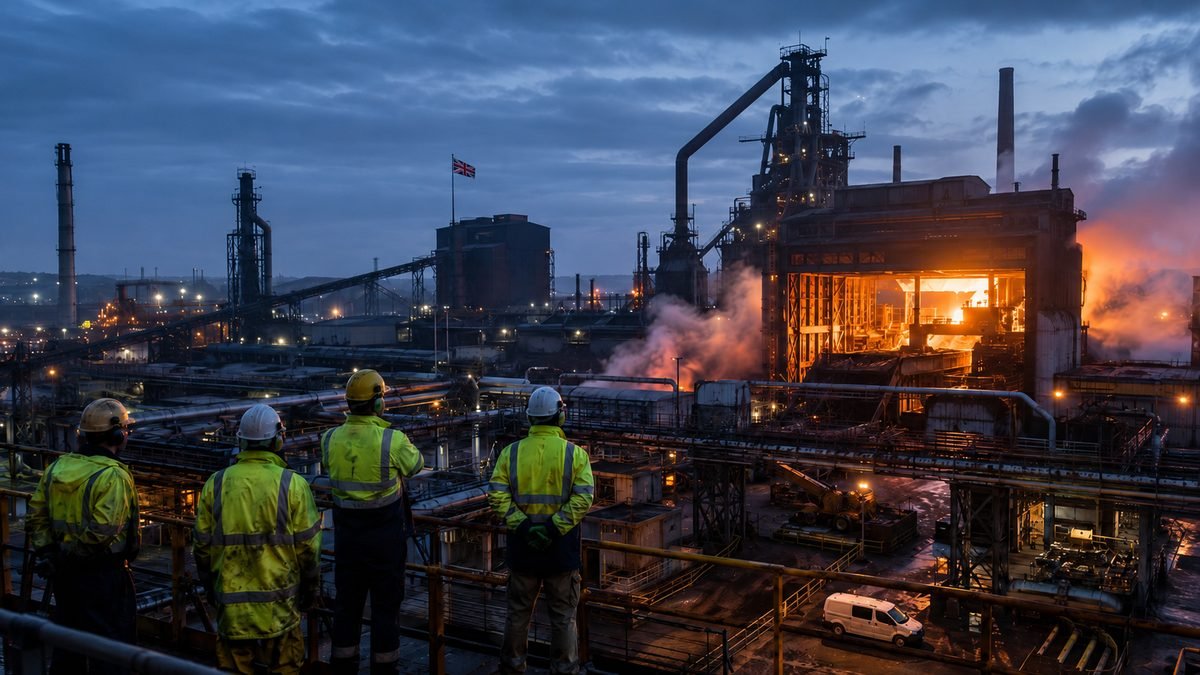
Scunthorpe is not simply another manufacturing site. Its furnaces, rolling mills, technical workforce and supplier relationships represent an industrial ecosystem built over generations. Steel plants cannot be switched off and restarted like ordinary factories. A blast furnace that cools in an uncontrolled way may be damaged beyond economical repair, while the loss of skilled teams can be almost impossible to reverse. That is why the government intervened operationally in April 2025 and why the final ownership decision has been treated as a national-capability issue rather than a normal corporate restructuring.
The human impact is equally important. Official figures cited by the government say the wider UK steel sector supported about 33,000 direct jobs in 2025 and a further 36,000 across supply chains. British Steel itself anchors employment in Scunthorpe and supports contractors, transport firms, engineering specialists and local services. Public ownership therefore protects more than payslips inside the works. It provides short-term security for a town whose economy, identity and housing market are closely linked to the plant's future.
What nationalisation does - and does not - guarantee
Public ownership gives ministers direct control over the immediate priorities: safe operations, continued production, reliable supplies of raw materials and a credible investment plan. The new non-executive leadership is expected to work with management, employees and trade unions. It can also align procurement and industrial policy more closely, including the government's ambition for a larger share of steel used in Britain to be made domestically. Those advantages are real, but they should not be confused with a guarantee that every current process or job will remain unchanged indefinitely.
British Steel still faces high energy costs, global overcapacity, pressure from lower-priced imports and the expensive transition away from carbon-intensive production. The government says it wants a competitive, low-carbon company and may explore private investment in the future. That means the present move is best understood as a platform for restructuring rather than a finished rescue. Decisions about blast-furnace life, electric-arc technology, raw-material supply and product mix will determine whether the business can eventually operate without open-ended public support.
The taxpayer and compensation question
Nationalisation also creates a financial debate. The legislation requires an independent valuer to assess whether compensation is payable to former owner Jingye. Regulations setting out the compensation scheme are expected later in the year. The final figure may depend on the company's condition, liabilities, investment needs and the legal valuation framework. Ministers will face pressure to demonstrate that any payment represents value for money, particularly after the state already spent heavily to keep production running and secure supplies.
Future investment could be larger than the compensation issue. Modernising a major steelworks requires capital for furnaces, power connections, environmental controls, processing equipment and workforce development. Supporters of nationalisation argue that these costs should be judged against the value of retaining sovereign capability, skilled employment and regional economic activity. Critics will ask whether public money could produce stronger returns elsewhere. A transparent business plan, regular reporting and clear milestones will be essential if the government wants to maintain public confidence.
How green steel changes the calculation
The long-term challenge is decarbonisation. Traditional blast furnaces use coke and produce substantial carbon emissions. Electric-arc furnaces can recycle scrap with lower direct emissions, especially when powered by low-carbon electricity, but they do not automatically make every grade of steel required by industry. Britain must decide how much primary steelmaking it considers strategically necessary and how that capability can be made compatible with climate targets. Technologies involving hydrogen, carbon capture and new iron-making processes remain costly or immature at full industrial scale.
A successful transition would connect energy policy, scrap availability, infrastructure demand and procurement. Stable orders from rail, offshore wind, defence and construction could help justify investment. Competitive electricity prices would improve the economics of cleaner production. Training would allow existing workers to move into new processes rather than being displaced by them. Nationalisation makes coordination easier, but it also places responsibility squarely on government to turn broad industrial ambitions into an executable sequence of investments.
What happens next
The immediate test is operational stability. Customers need confidence that orders will be delivered, employees need clarity about shifts and investment, and suppliers need assurance that invoices will be paid. The next phase should reveal more about leadership, financing and the route to a sustainable production model. Trade unions are likely to press for job guarantees and a stronger commitment to British steel in public contracts, while customers will focus on quality, price and reliability rather than ownership alone.
For Scunthorpe, nationalisation removes the threat of an abrupt collapse but begins a new and demanding chapter. For the wider economy, it signals that the government is prepared to intervene when a company is considered essential to national resilience. The success of that approach will be measured not by the announcement itself, but by whether British Steel can modernise, win orders, reduce emissions and eventually demonstrate that strategic public ownership can produce a durable industrial business.
Sources & verification
- UK Government - British Steel brought into public ownership
- UK Government - Steel Strategy
Filed under Business · Written by Rajan Mehta
You may also like to read