Patriot Front's July Fourth March in Washington Tests How a Capital Handles Extremist Spectacle
A masked Patriot Front march through Washington DC during the US 250th anniversary raises hard questions about public space, symbolism and response.
Marcus Reeve
Writer ·
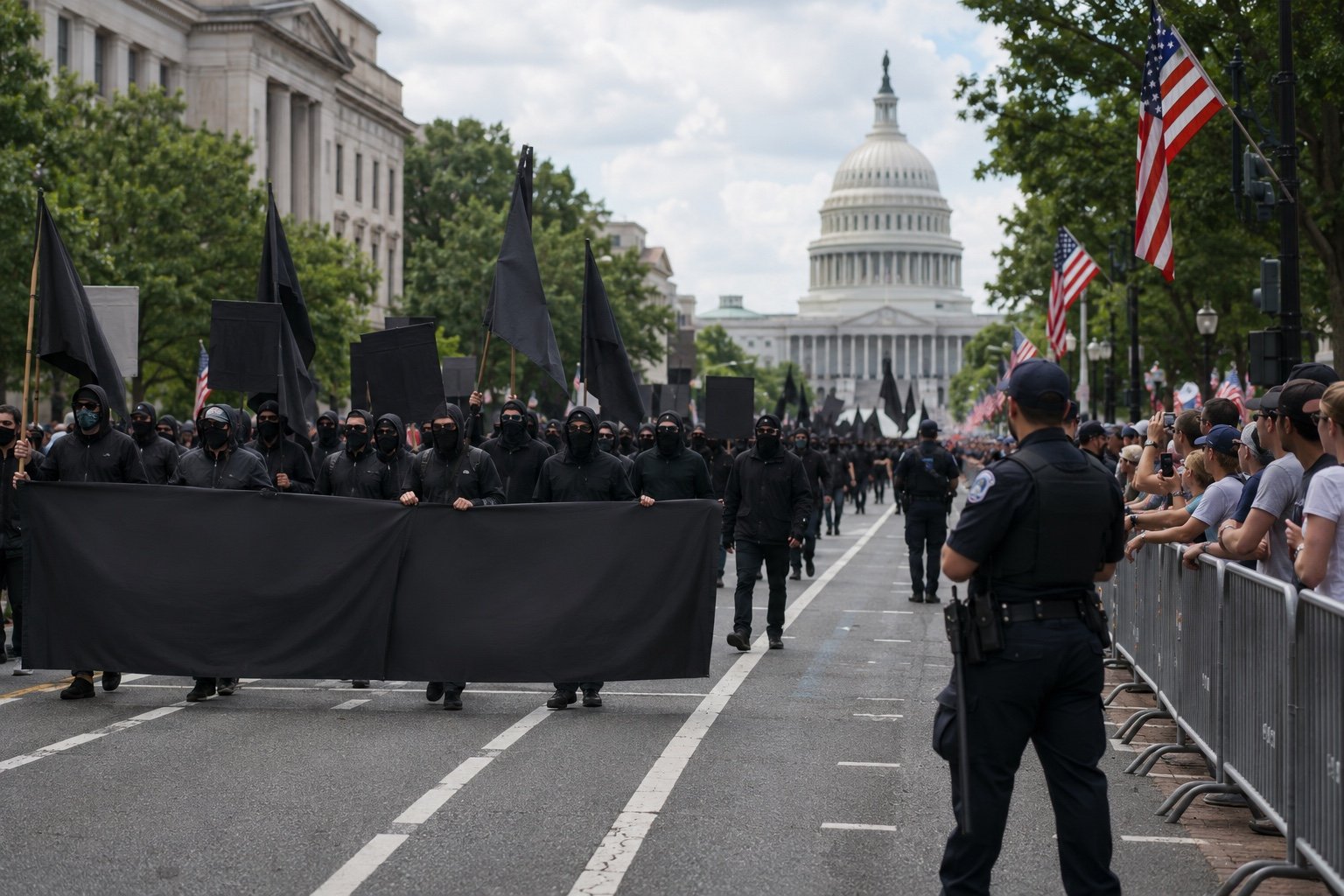
The significance of a political march is rarely just its headcount. Timing, setting and symbols do much of the work — which is why a Patriot Front demonstration in Washington DC on 4 July 2026, in the middle of the United States' 250th anniversary celebrations, warrants sober attention rather than either alarm or dismissal.
What happened
According to Guardian reporting, members of Patriot Front — a group founded by Thomas Rousseau after the 2017 Unite the Right rally in Charlottesville, and widely described by researchers as white supremacist and neo-fascist — gathered at Union Station and marched towards Capitol Hill. Members wore white masks and carried banners, including a Confederate flag. Counter-protesters were present, the event was extensively documented on social media, and police were aware of the demonstration. No large-scale disorder was reported in the account.
Why it matters
The march operated on two levels at once: a physical procession through public space and a media performance built to circulate. The masks, matching dress and disciplined formation are not incidental — they are a visual strategy designed to project strength and invite amplification, whether from supporters or critics. The choice of date sharpened the point. National anniversaries are moments when countries argue over their own story, and a group marching through the capital during a 250th-anniversary weekend is attempting to borrow legitimacy from a civic occasion it did not build. Lawful use of public space is protected in the United States precisely because unpopular expression may occur there; tolerance of that expression is not endorsement of it.
The counter-view
There is a genuine tension in how institutions and media should respond. Overreaction risks handing a relatively small organisation the outsized historical role it seeks, and can feed narratives of persecution. Underreaction risks leaving the communities targeted by the group's messaging feeling abandoned, and lets intimidation pass unremarked in the nation's most symbolic public spaces. Police face a parallel balance: managing order and protecting rights — including those of counter-protesters — while recognising that highly performative demonstrations are sometimes designed to provoke a reaction that becomes the story. The most durable answer is factual discipline: report what happened, identify the group accurately, note the public-safety response, and resist language that inflates the event's scale. A democracy does not need to pretend such movements are harmless, and it does not need to grant them grandeur either.
What happens next
The anniversary year will bring more ceremonial dates, and with them more attempts by fringe movements to attach themselves to national symbolism. The practical tests are consistent: whether authorities keep public events safe without curtailing lawful expression, and whether public conversation can describe extremist activity clearly without making it seem larger than it is. The march did not define July Fourth — but it showed how quickly public ceremony can be used as a stage, and why disciplined attention beats both panic and indifference.
Sources: reporting by The Guardian.
The NE Times is an independent news and analysis publisher. Our articles combine factual reporting with clearly-written, impartial analysis. Content is for general information and does not constitute professional advice. Disclaimer.
You may also like to read
The Brooklyn Bridge Fire Shows What Civic Spectacle Really Depends On
A fireworks malfunction set the Brooklyn Bridge alight during America's 250th Independence Day show — a test of the invisible systems behind celebration.
America's holiday weekend showed how summer risks now compound
Three children died when a storm capsized a boat on Geneva Lake, and nearly a million lost power as heat returned — a case study in overlapping summer hazards.
Extreme Heat and Storms Turn America's 250th Birthday Into a Test of Public Ceremony
Washington's July Fourth parade was cancelled in dangerous heat and the National Mall evacuated for storms as America 250 met climate reality.
Senate Rebukes Trump Over Iran War Powers In Rare Bipartisan Vote
The US Senate passed a war powers resolution limiting military action against Iran by 50-48, with several Republicans crossing the aisle.