America's holiday weekend showed how summer risks now compound
Three children died when a storm capsized a boat on Geneva Lake, and nearly a million lost power as heat returned — a case study in overlapping summer hazards.
Marcus Reeve
Writer ·
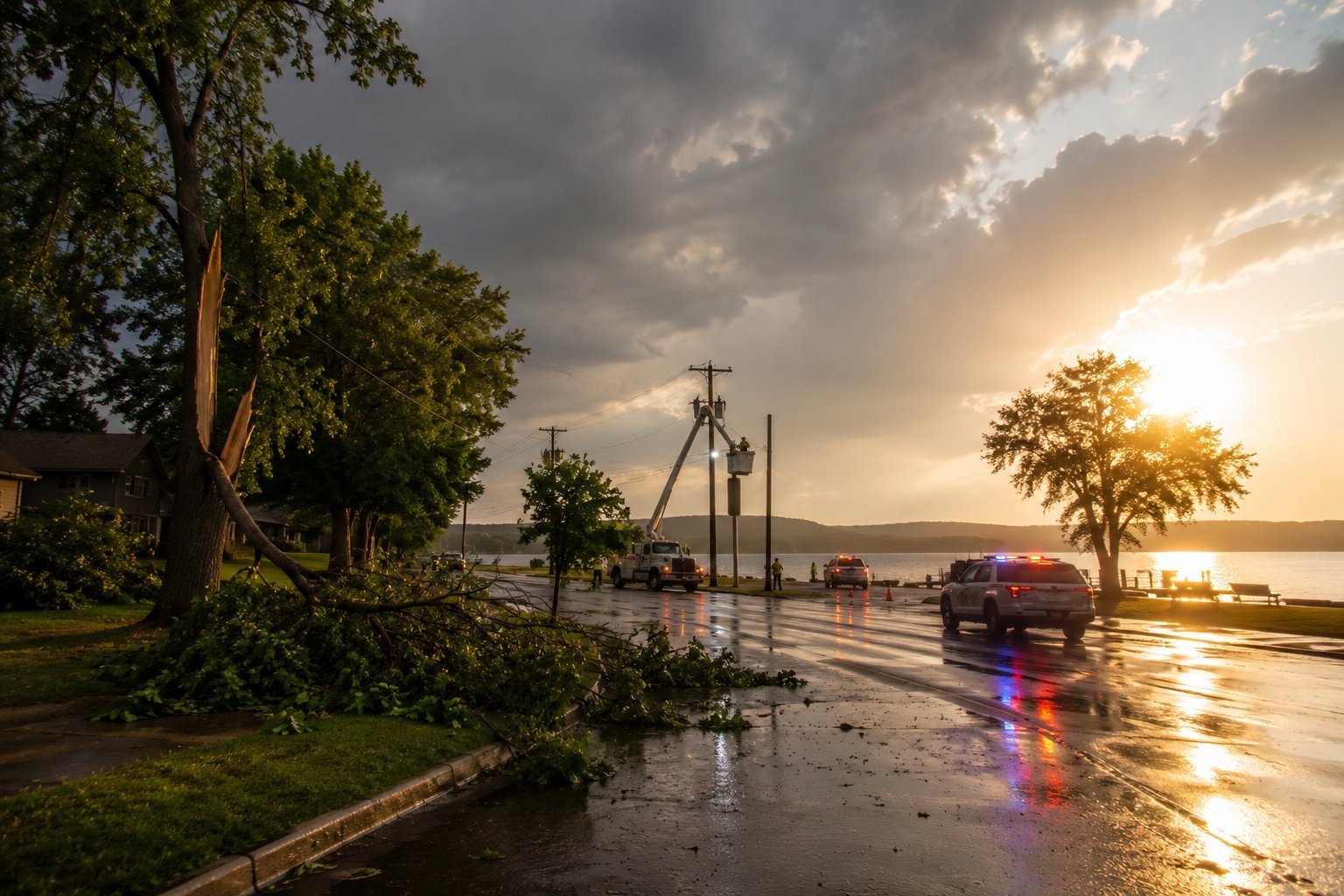
The July Fourth weekend in the United States assembled the familiar ingredients of summer celebration — travel, lakeside gatherings, fireworks, crowded public spaces — and delivered a hard lesson in how quickly weather risk can compound when storms and heat arrive together.
What happened
A severe storm over Geneva Lake in Wisconsin left three children dead after a private motorboat capsized. According to police cited by the Associated Press, the boat carried ten people, including four children, and was trying to reach safety when wind and waves overwhelmed it; six adults and one child were rescued. The AP reported that the children who died were wearing life vests. Across Wisconsin, Michigan, Illinois, Pennsylvania, Ohio, New York and New Jersey, storms left nearly one million utility customers without power at one stage, with around 750,000 still cut off by midday Saturday. Lake Geneva's mayor declared an emergency after storm damage, several cities cancelled or rescheduled fireworks, and extreme heat returned quickly to parts of the Northeast even as communities cleared fallen trees.
Why it matters
The life-vest detail is the devastating one, because it complicates every tidy safety narrative. Life jackets matter and save lives — yet correct precautions can still be overwhelmed when a sudden storm turns a holiday outing into an emergency within minutes. That shifts the lesson from equipment to timing: alerts must reach people before they are on the water, marinas and event organisers need clear thresholds for pausing activity, and families need decision rules simple enough to follow under stress. If thunder is near or wind rises sharply, leaving early beats racing the storm.
The bigger picture
The weekend's core lesson is that hazards now overlap. A thunderstorm, a mass power outage and a heatwave each demand a response; together they create a qualitatively different emergency. A power cut during extreme heat is not an inconvenience — it removes air conditioning, refrigeration, medical-device support and communications precisely when they are most needed, and the burden falls hardest on older residents, children and those who cannot relocate. Officials who cancelled festivals, like Belleville, New Jersey's mayor who told residents safety would come first, made unpopular but defensible calls: public events rest on assumptions about transit, power and weather that had visibly collapsed. Infrastructure resilience — tree management, grid hardening, repair logistics — is less dramatic than rescue operations, but it shapes who suffers after the storm passes.
What happens next
The Geneva Lake investigation continues, and the tragedy deserves restraint rather than blame built on incomplete information. The facts so far describe a sudden storm, a boat that could not outrun it, and children who did everything right and still could not be saved. The broader takeaway is sober: preparation helps, but severe weather can exceed preparation, which is why early avoidance and warning systems matter most. Heat, storms, travel and outdoor recreation are now tightly linked public-safety issues. Communities that plan for them together will fare better than those that keep treating them as separate problems.
Sources: reporting by Associated Press.
The NE Times is an independent news and analysis publisher. Our articles combine factual reporting with clearly-written, impartial analysis. Content is for general information and does not constitute professional advice. Disclaimer.
You may also like to read
The Brooklyn Bridge Fire Shows What Civic Spectacle Really Depends On
A fireworks malfunction set the Brooklyn Bridge alight during America's 250th Independence Day show — a test of the invisible systems behind celebration.

Europe's record heatwave becomes a public-safety emergency as drownings mount and red alerts spread
Extreme temperatures across the continent have moved beyond a weather story into a wider safety crisis, with dozens of heat-related deaths, school closures and warnings that Britain could see record June heat.
Patriot Front's July Fourth March in Washington Tests How a Capital Handles Extremist Spectacle
A masked Patriot Front march through Washington DC during the US 250th anniversary raises hard questions about public space, symbolism and response.
Europe heatwave smashes records as health and infrastructure buckle
Britain logs its hottest June day and France its hottest day on record, with temperatures near or above 40C triggering red alerts across western Europe.